
Elevate Your Photography Career and Create Momentum
The Power of Personal Projects
AI Meeting Recap
Quick recap
The meeting focused on strategies for personal projects and portfolio development for photographers. Don emphasized the importance of creating 3-5 images weekly through mini-shoots and shared ideas for projects that could enhance portfolios and attract clients. He discussed the value of social media for visibility and suggested tools like Metricool and Content360 for managing posts. Don also highlighted the significance of email marketing and encouraged participants to send out emails regularly, even if initially without expecting jobs. The group discussed various personal project ideas, including Laura’s plan to photograph bikes and Jessica’s tea bag series. Don demonstrated post-processing techniques in Lightroom to enhance images. The conversation ended with encouragement for participants to actively promote their work and share it with potential clients.
Next steps
- All participants: Send out 10 marketing emails (if not already done); continue sending emails regularly as practice
- Jessica: Continue working on setting up and using Content360 for social media scheduling
- Mike: Test Metricool for scheduling up to 20 social media posts per month
- All participants: Create 3-5 new images per week through mini-shoots/personal projects for portfolio and social media content
- All participants: Review Don’s PDF (to be posted) with 15 project ideas for potential personal projects
- Laura: Review Aventon’s website and Instagram to identify missing content, then create and tag relevant photos
- Jessica: Share new tea bag photos in Elevate Facebook group for feedback
- Don: Post link to folding table in chat
- Don: Post PDF with 15 project ideas
- Don: Review Jessica’s new photos in Elevate group
- Don and Micheal: Meet on Monday to discuss pending matter
- All participants: Watch for announcement of possible special meeting next Saturday
- All participants: Review “New Email Practices for the Solopreneur” Substack post if not already read
- All participants: Get portfolio/work in front of potential clients through various outreach methods (email, social media, in-person)
Summary
Email Marketing and Social Strategy
The group discussed email marketing progress, with some members reporting delays while others maintained consistent sending. Don advised on social media strategy, recommending Metricool for basic scheduling needs and Content360 for more advanced requirements, while emphasizing that social media should primarily serve to increase website visibility rather than generate direct clients. The conversation ended with a detailed discussion about personal projects, with Don encouraging members to create portfolio-building projects featuring 5-25 images, suggesting that such projects could lead to client opportunities even if initially created for personal development.
Home Photography Studio Setup Ideas
The group discussed setting up home photography studios, with Don sharing a link to a foldable dining table with storage that can be used for photography shoots. Trish and Inge shared their experiences with similar multi-purpose tables, while Michael mentioned plans to include project pieces on his portfolio page. The conversation concluded with Inge describing a repurposed kitchen cart she uses for small-space photography.
Mini-Shoot Formula for Food Photography
Don discussed creating a mini-shoot formula, encouraging photographers to schedule regular shooting sessions and collect props for food photography. He suggested using mood boards on platforms like Pinterest or Canva to plan and share projects, emphasizing the importance of creating 3-5 images weekly. Don also shared a personal anecdote about his wife’s success as a photography representative, highlighting the value of having a dedicated portfolio reviewer.
Behind-the-Scenes Photography Portfolio Technique
Don shared his experience with a successful photography portfolio technique used by a rep, which involved showing behind-the-scenes images of the photographer’s process in 2.25 square slides. He noted that while this approach worked well for the rep, it was less effective when he tried it as the photographer. The group discussed how this method could be effective on a modern website, allowing viewers to see the photographer’s work without the photographer being present in the images. Don also mentioned a blog by photographer Brad Trent, who documented his editorial photography process, including a notable example of helping Madeleine Albright pose for a photo.
Social Media Content Strategy Discussion
Don discussed the importance of regular content creation for social media and portfolio building, emphasizing that smaller, frequent shoots can be just as effective as large productions. He shared ideas for projects, including a series of simple, creative shots that could be used across various platforms. Philippe shared his motivation for photographing a pair of boots, which sparked a discussion about storytelling through photography. Laura mentioned a previous photo shoot featuring her bike and expressed interest in continuing the series with Aventon electric bikes.
Photography Business Growth Strategies
Don advised Laura to analyze Aventon’s social media presence and identify opportunities to provide missing content, emphasizing the importance of tagging and engaging with potential clients on Instagram. He shared personal experiences and strategies, such as offering free services to build credibility and leveraging referrals, to help photographers secure jobs and grow their businesses. Don stressed the value of physical outreach, networking, and offering incentives for referrals, while highlighting the need for photographers to view their work as a job rather than an art.
Personal Updates and Creative Projects
The group discussed various personal updates, including Laura’s discovery of her passports in an electronics cabinet, which inspired her plans to travel to South Africa in August for a photography project. Don shared progress on his home renovation, mentioning the completion of drywall and the expected timeline for the garage and studio, which will be finished before the main house. Jessica presented new photos, including a creative shot of a chamomile tea bag, which she processed using Lightroom. The conversation ended with a reminder for everyone to send out emails and for Jessica to share any new work with Don for review.
Advanced Photo Editing Techniques
Don demonstrated advanced photo editing techniques using masks and layers in Camera Raw, showing how to create subtle vignettes and highlight specific areas of an image. He emphasized the importance of masking as a powerful tool for photo editing, comparing it to traditional darkroom techniques. The group discussed the need to share their work and hear success stories in the coming weeks. Don and Micheal agreed to meet on Monday to address an unspecified issue.
Stop Waiting for Permission: How Personal Projects Open Doors (and Get You Hired
They aren’t just “for fun.” They are your most powerful marketing tool.
Personal projects are not fluff.
They are not filler to pad a thin portfolio.
When executed correctly, they are the most effective marketing tool you have as a working photographer.
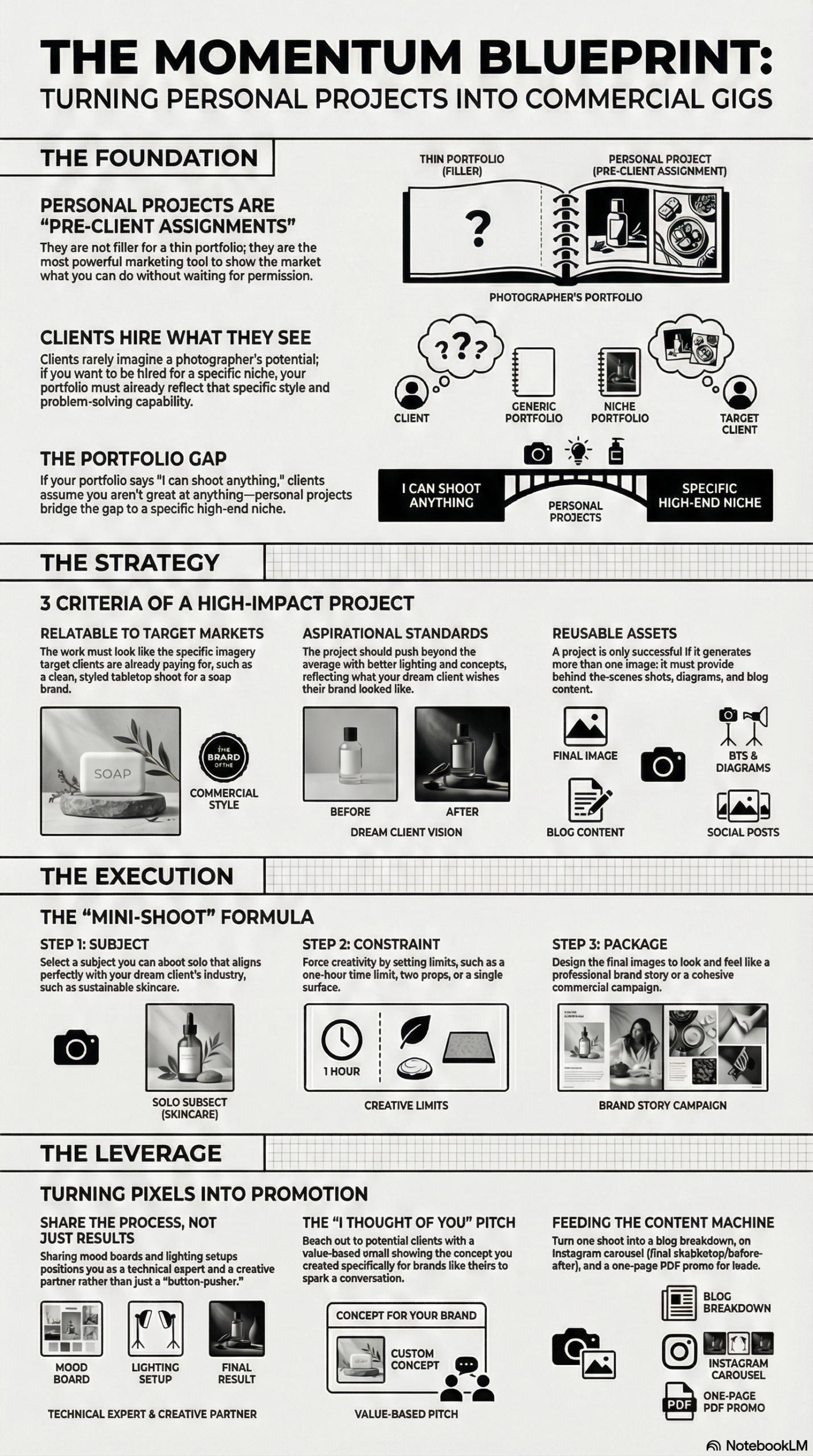
Many photographers fall into the trap of thinking personal work is just for creative play. But in reality, these projects are “pre-client assignments”. They are your opportunity to show the market exactly what you can do, without waiting for someone to give you permission—or a budget—to do it.
If you want to open doors for new clients and promotion, you have to stop waiting to be picked and start showing the work you want to get hired for.
The Golden Rule: Clients Hire What They See
Clients do not have the time or the inclination to imagine what you are capable of. They hire based on what they see.
If your portfolio says, “I can shoot anything,” clients will assume you aren’t great at anything.
If you want to be hired for high-end food photography, you cannot lead with portraits. If you want to shoot products, you cannot lead with events.
A strategic personal project bridges this gap. It allows you to create a self-assigned, self-produced shoot that reflects the specific niche you want to target.
It tells the market: “I understand this style, this problem, and here is what I would do with it”.
The 3 Criteria of a Killer Project
Not all personal work is created equal. To move the needle on your career, your project should hit three specific marks:
1. Relatable: It should look like the kind of work your target clients are already hiring photographers to create. A boutique soap company is more likely to respond to a clean, styled tabletop shoot than an abstract art piece.
2. Aspirational: It should push beyond the average. Better lighting, better concept, better styling. Make it look like what your dream client wishes their brand looked like.
3. Reusable: It should generate more than just a final image. You need behind-the-scenes (BTS) shots, lighting diagrams, and blog posts to get as much mileage out of the shoot as possible.
The “Mini-Shoot” Method
You don’t need a massive budget or a full crew to make this happen. In fact, some of the most effective portfolio builders are “Mini-Shoots”. These are focused, 1–2 hour sessions with a clear goal.
To execute a Mini-Shoot effectively, use this formula:
Subject → Constraint → Package.
• Subject: Pick something you can shoot solo that aligns with your dream client (e.g., sustainable skincare products).
• Constraint: Set limits to force creativity, such as using only one surface, two props, and a one-hour time limit
• Package: Design the final images to look like a brand story or a campaign.
Turning a project into Promotion
Here is where it all comes together.
A personal project is only a marketing tool if you actually market it. You are not just making an image; you are making a campaign.
1. Share the Process (Not Just the Result) One of the biggest mistakes photographers make is only showing the final shot. Clients love seeing how you think. Share your mood boards, your lighting setups, and the challenges you solved during the shoot. This builds trust and positions you as a technical expert, not just a button-pusher.
2. The “I Thought of You” Pitch
Once your project is polished, use it to open doors. Reach out to 3–5 potential clients in that specific niche. Do not ask for a job. Instead, send a value-based email:
“I recently created a concept for brands like yours and thought it might spark ideas for your next campaign. Let me know if you’d be open to chatting”.
This approach transforms you from a needy freelancer into a proactive creative partner.
3. Feed the Content Machine A single personal project can fuel your marketing for weeks. You can turn one shoot into:
• A Blog Post: Breakdown the concept, execution, and results.
• Instagram Carousel: Slide 1 is the final shot, Slide 2 is the setup, Slide 3 is the before/after.
• A PDF Promo: Package the series into a one-page PDF to send to warm leads.
The Takeaway
You are no longer a hobbyist waiting for inspiration. You are a business owner building a pipeline.
Personal projects are not what you do between gigs; they are what create the gigs. Every project you shoot is a business card, a pitch, and a case study rolled into one.
So, stop waiting for the perfect time.
Pick a subject, set a constraint, shoot it, and share it.
That is how you build momentum.
That is how you get hired.
PROJECT IDEA PDF
DOWNLOAD AND PRINT
Workbook Chapter 5: Personal Projects That Sell
1. Framing the Chapter
Why this matters:
Personal projects aren’t just creative play—they’re powerful business tools. A smart personal project builds your portfolio, markets your skills, and attracts the kind of clients you actually want. When designed with intent, personal projects blur the line between practice and promotion.
2. Exercises
A. The 3-Criteria Project Builder
A personal project that sells should hit at least 2 of these 3 criteria:
☐ It excites me creatively
☐ It builds skills I want to be hired for
☐ It shows work my ideal clients need
Brainstorm three possible projects:
- __________________________________________
- __________________________________________
- __________________________________________
Chosen Project: __________________________________________
Why it qualifies: __________________________________________
B. Shoot Plan by Niche
Design your project so it mirrors a real assignment. That way, clients can imagine hiring you for similar work.
| Planning Element | Your Notes |
| Subject / Concept | |
| Style / Approach | |
| Where It Fits in My Portfolio | |
| Target Clients Who Would Care |
C. Process = Marketing
Document your project as you create it. Behind-the-scenes (BTS), lighting notes, and your problem-solving process are all content you can share.
Make a quick plan for what to capture:
☐ BTS photos or videos
☐ Notes on challenges + solutions
☐ Lighting diagrams or setups
☐ Final selects ready to share
D. Turn Personal → Paid
Once finished, pitch your project to 3–5 prospects who could benefit from this type of work.
| Prospect | Why They’d Care | Outreach Plan |
| Prospect 1 | ||
| Prospect 2 | ||
| Prospect 3 |
3. Reflection Prompts
☐ Which past personal projects gave me momentum—or stalled out? Why?
☐ How can I make this project feel both creatively satisfying and market-ready?
☐ What story does this project tell about the kind of photographer I am becoming?
4. Weekly Action Plan
☐ Brainstorm and choose your personal project using the 3-criteria framework.
☐ Complete your Shoot Plan with subject, style, and target clients.
☐ Make a list of BTS and process elements you’ll capture.
☐ Finish and package the project, then pitch it to at least 3 prospects.
5. End-of-Chapter Checkpoint
☐ I have chosen a project that meets at least 2 of the 3 criteria.
☐ I have completed my Shoot Plan.
☐ I have documented the process for marketing content.
☐ I have pitched the finished project to at least 3 prospects.
PROJECT 1
Title: The Quiet Object
Client Type Hint:
Boutique brands, skincare startups, handmade product companies
What It Proves:
You can make one object feel important.
No tricks. No clutter. Just light, form, and restraint.
Series Requirement (4 images):
- Pure hero shot
- Detail crop (texture, label, edge, or surface)
- Slight angle variation (adds dimensionality)
- Negative-space version (designed for copy placement)
Creative Parameters:
- One product only
- One surface
- One primary light
- Neutral background
- No props
This is about respect. Treat the object like it matters.
Interpretation Hook:
Clinical? Soft? Warm? Editorial?
Your style shows in how you restrain yourself.
PROJECT 2
Title: Surface & Shadow
Client Type Hint:
Cosmetics, ceramics, specialty food, handmade goods
What It Proves:
You understand how surface choice and shadow design affect brand tone.
Series Requirement (4 images):
- Light field (bright, open, optimistic)
- Dark field (moody, sculptural, controlled)
- Detail emphasizing texture
- Overhead or near-overhead composition
Creative Parameters:
- Same object
- Two different lighting moods
- Surface must matter
- Shadows must be intentional, not accidental
Interpretation Hook:
Is your brand voice quiet luxury? Playful? Scientific?
Show it through lighting choices.
PROJECT 3
Title: The Honest Set
Client Type Hint:
Small food producers, kitchen brands, cafés
What It Proves:
You can create a believable “brand moment” without building a fake lifestyle.
Series Requirement (5 images):
- Hero product image
- Product + ingredient
- Process detail
- Texture close-up
- Simple composition for packaging or menu use
Creative Parameters:
- One food product
- Real ingredients only
- No forced lifestyle props
- Natural, believable styling
Interpretation Hook:
Rustic? Modern? Clean? Earthy?
You decide how honest looks.
PROJECT 4
Title: Three of a Kind
Client Type Hint:
Retail packaging, e-commerce brands, subscription services
What It Proves:
You can create visual consistency across a set of related products.
Series Requirement (4 images):
- Group hero (three items together)
- Individual shot #1
- Individual shot #2
- Individual shot #3
All must feel like part of the same family.
Creative Parameters:
- Same lighting
- Same surface
- Same framing logic
- Variation comes from product, not chaos
Interpretation Hook:
Order vs. play.
Symmetry vs. rhythm.
Your design instincts show here.
PROJECT 5
Title: The Functional Detail
Client Type Hint:
Manufacturers, small hardware companies, tool makers, cosmetics
What It Proves:
You can photograph use and design intent, not just pretty shapes.
Series Requirement (4 images):
- Hero product
- Functional close-up (button, lid, opening, texture)
- In-use suggestion (without showing a person)
- Graphic composition suitable for ad copy
Creative Parameters:
- Show purpose
- Show clarity
- No gimmicks
Interpretation Hook:
Technical? Warm? Consumer-friendly?
Your visual language defines the answer.