
Elevate: January 31, 2026: The Nitty Gritty of Marketing
Meeting Notes
Quick recap
The team discussed social media content strategies and Instagram best practices, with Don emphasizing the importance of using carousels and building email contacts for networking. They explored various business and sales strategies, including the use of incentives rather than discounts to maintain perceived value and encourage customer purchases. The conversation ended with discussions about photography pricing approaches, website updates, and specific lighting techniques for product photography, along with guidance on proper mailing techniques for reaching out to restaurants.
Next steps
- All participants: Develop and share your social media funnel plan (e.g., how often you’ll post on Instagram, Facebook, create blog posts, etc.) with Don.
- All participants: Develop and share your incentive plan/ideas for client offers with Don.
- Laura: Share Notion workbook link with interested participants (those who leave their emails in the chat).
- Trish: Test snail mail delivery time by mailing something to herself before sending out marketing materials to local businesses.
- Trish: Check with the post office for requirements on sending note cards/envelopes to ensure proper configuration and stamp placement.
- Don: Post the link and password for the One Light class in the chat for those who missed it.
- Jessica: Resubmit updated wine bottle photos to Don for review.
- All interested participants: Review the One Light class materials using the provided password.
- Mike: Have website ready by Monday. (Implied as an update, but stated as “gonna have his website on Monday”)
Summary
Warehouse Renovation Photography Strategy
Michael secured a new project to photograph a client’s rehabilitated warehouse property, with plans to document the property before and during renovations. The team discussed Instagram content strategy, with Don emphasizing the importance of using carousels rather than stories to showcase a complete story or process through multiple images, and explaining that clients prefer seeing the thought process behind photos rather than just final results. Don also advised Philippe to start building email contacts early, even if initially busy, as networking takes time to develop.
Social Media Content Strategy Discussion
The group discussed social media content strategies, particularly for Instagram carousels and posts. Laura suggested creating quick reels from photos to boost visibility in the algorithm, while Trish mentioned cross-posting content to reach different audience segments. Don emphasized the importance of blogs for SEO and having a call-to-action on every page. The conversation also covered content recycling and repurposing, with Don sharing a personal anecdote about reinterpreting old content as new. Jessica expressed admiration for Gary Vee’s content strategy and work ethic, though Don noted some reservations about Vee’s NFT ventures.
Strategies for Effective Pricing and Incentives
The group discussed the business strategies of Gary Vaynerchuk, who started by focusing on arbitrage opportunities and grew his ventures through hard work and consistent messaging. They then explored the difference between incentivizing and discounting in pricing, with Don emphasizing that photographers should avoid discounting their work and instead offer incentives like additional services or bundled products to maintain perceived value. The discussion concluded with Don explaining the distinction between incentivizing (offering special deals before the bid) and discounting (giving price reductions after the bid), using car sales as an example of how incentives can be used effectively.
Incentive Strategies for Customer Engagement
The group discussed various sales and marketing strategies, focusing on the use of incentives rather than discounts to encourage customer purchases. Don shared examples of successful incentives, including a car trade-in deal and a camera purchase with added lenses. The conversation also touched on the psychology of selling, emphasizing the importance of creating a reason for customers to choose a business over competitors. The group briefly discussed Valentine’s Day marketing opportunities and the value of offering a free creative development session for potential clients.
Creative Pricing and Referral Strategies
Don shared his pricing strategy for creative development sessions, charging $2.50 for 30 minutes with the fee credited back if the client hires him. He emphasized the importance of bundling deliverables and offering incentives after making the pitch to create urgency. Don also discussed using incentives for referrals, suggesting non-cash rewards like hotel stays or restaurant meals as tax-deductible business deductions. Laura shared her experience offering spa days and collaborative luncheons with other wedding professionals to encourage referrals, while Don advised against lowering shoot fees and suggested adjusting other costs instead.
Transparency and Pricing Strategies
Don discussed the importance of transparency in pricing, particularly in the medical and veterinary industries, and emphasized the value of photographers charging fair rates for their work. He encouraged team members to develop incentive plans and share their marketing funnel strategies for social media platforms like Facebook and Instagram. Don also stressed the significance of maintaining professional standards by avoiding undervalued work and instead offering services at appropriate rates or providing them for free if desired.
Restaurant Outreach Strategy Discussion
The group discussed strategies for reaching out to restaurants, with Don advising Trish to use both snail mail and social media DMs, and Jessica suggesting checking Facebook pages for business emails. They explored creative options for mailings, including using photo note cards with Trish’s design on the outside and a letter inside, with Don encouraging her to experiment with this approach. The discussion concluded with Don providing guidance on proper mailing techniques, including using clear plastic envelopes and checking post office requirements for stamp placement.
Per-Shot Pricing Strategy Discussion
The group discussed pricing strategies, with Don explaining his approach of charging per shot rather than hourly to avoid penalties and provide clients with clear costs. Philippe shared an experience about an illustrator being approached with an hourly rate, which led to a discussion about the benefits of per-shot pricing. The conversation concluded with updates about website launches, including Mike’s upcoming website and Jessica’s recent updates to her wine bottle photos, which Don promised to review.
Product Photography Lighting Tips
Don provided feedback on Jessica’s product photography, particularly focusing on wine bottle shots, and shared three key lighting tips: getting the horizon line right, using a scrim to control lighting, and positioning the scrim three times the size of the bottle. Don also shared the password (BigLight2026) for accessing the One Light class materials, which includes videos and instructions for portfolio images. The class requires participants to submit five portfolio images, with two each in food, still life, product, and portrait categories, all lit with one light source.
FUNNELS AND INCENTIVES
Understanding the Feed/Funnel Connection
HOW TO USE SOCIAL MEDIA FOR A "FUNNEL"
From Feed to Funnel
How to Turn Instagram + Your Blog Into Marketing Machines
You’ve shot the work.
You’ve defined your niche.
You’ve even crafted that sharp intro email.
Now it’s time to make your digital presence do some of the heavy lifting.
Because let’s be honest — posting a nice photo on Instagram with “Shot this last week ?✨” isn’t getting you anywhere.
Neither is letting your blog collect cobwebs because “nobody reads blogs anymore.”
That’s not marketing. That’s passive scrolling with a side of creative burnout.
This chapter is about treating your Instagram and blog like strategic assets — not afterthoughts.
We’re turning content into connection.
And connection into clients.
Let’s Define the Funnel (Don’t Worry, No Marketing Jargon)
When we say “funnel,” here’s what we mean:
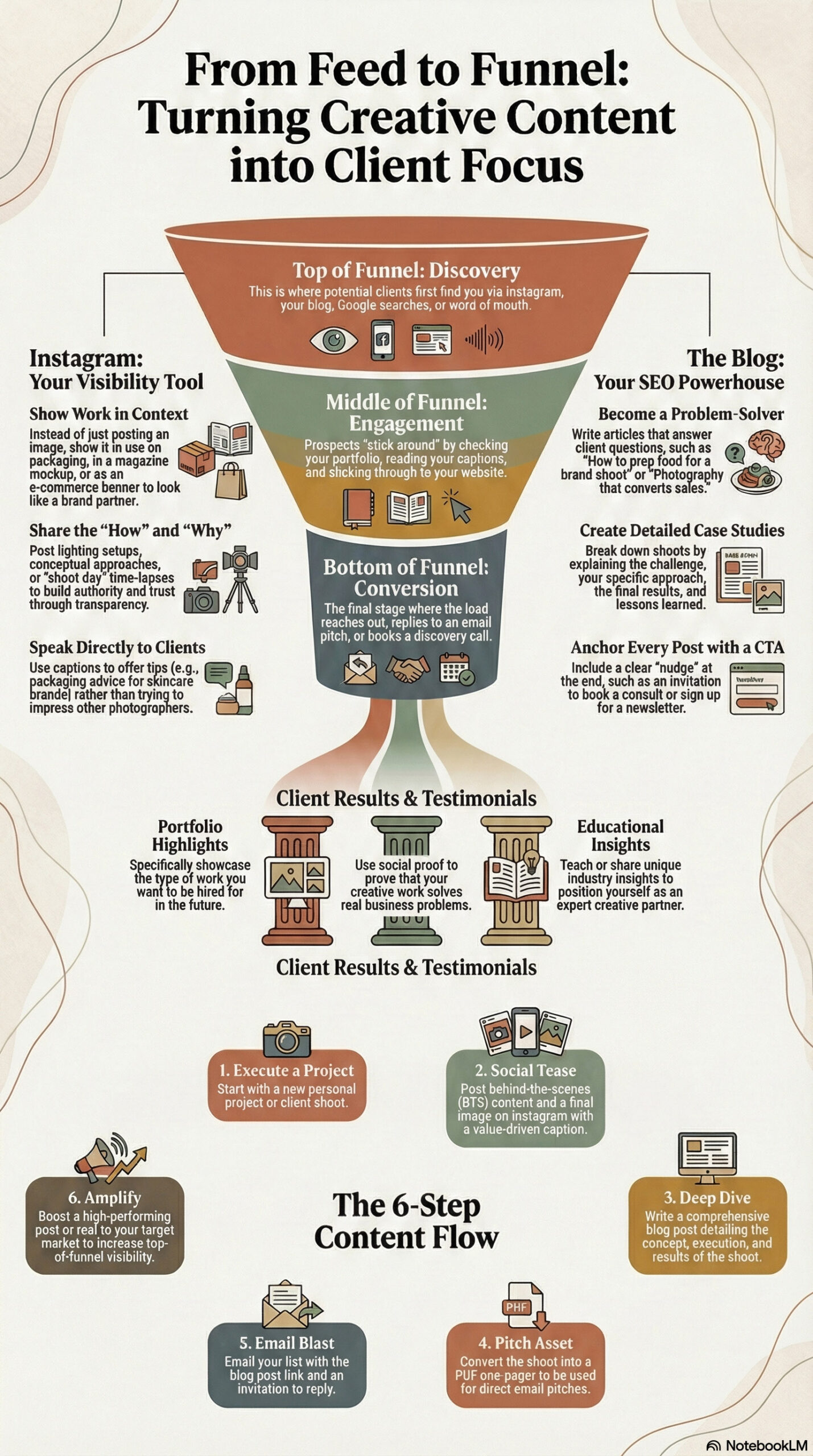
- Top of Funnel: Someone finds you — IG, blog, Google, word of mouth
- Middle of Funnel: They stick around — check your work, read a caption, click your site
- Bottom of Funnel: They reach out, reply to your email, or book a call
Your Instagram and blog live at the top and middle of that process.
They introduce you, show your value, and nudge the right people closer to hiring you.
But only if you treat them like tools — not trophies.
Instagram: It’s Not Just for Likes
Instagram is your fastest, easiest brand visibility tool.
But only if you shift how you use it.
Here’s what works for photographers in Phase Two:
- Show the Work in Context
Clients don’t hire images. They hire results. So show your images in use:
- On packaging
- In a mockup
- As a magazine ad or e-comm banner
- On an IG grid layout (like they’d use it)
This makes you look like a brand partner — not just a picture-taker.
- Share Your Process
People love behind-the-scenes. But more than that, they love knowing how you think.
- Show your lighting setup
- Talk through how you approached the concept
- Post a reel or time-lapse of the shoot day
- Share what went wrong — and how you fixed it
This builds authority, and more importantly, trust.
- Speak to Your Clients, Not Your Peers
You’re not trying to impress other photographers.
You’re building trust with people who might hire you.
Use your captions to speak directly to your target clients:
- “If you’re a boutique food brand prepping for holiday season, here’s what you should be thinking about visually…”
- “Packaging tip for skincare brands: avoid too much white space unless your images are doing the heavy lifting.”
- “This lighting setup is ideal for small product shoots where you need both contrast and soft highlights.”
That’s value. That’s what makes someone save the post, follow you, and eventually reach out.
Content Pillars: Know What to Post
Rotate between these four types of posts. It keeps your content fresh, balanced, and effective:
- Portfolio Highlights — Show the work you want more of
- Behind the Scenes — Build trust and curiosity
- Client Results or Testimonials — Prove your work solves problems
- Educational/Insightful — Teach, inspire, or share insights
This gives your feed rhythm. It builds a story. And most importantly — it positions you as a creative partner, not just a hired hand.
The Blog: Your SEO Powerhouse
Instagram moves fast. Blogs stick around.
Your blog isn’t dead — it’s just underused.
Done right, it’s how clients find you, understand you, and decide to work with you — all without you being in the room.
Let’s unpack how to use it.
- Think Like a Problem-Solver
Your blog isn’t a diary. It’s a resource.
Write articles that answer real questions your target clients might Google:
- “What kind of product photography helps convert more sales?”
- “How to prep your food for a brand shoot”
- “The best lighting setups for showing off packaging texture”
Each one builds trust, improves SEO, and positions you as an expert — not just a vendor.
- Break Down Your Shoots
Turn personal projects or client work into case studies:
- The challenge
- The approach
- The final results
- The lessons learned
This is gold for local SEO, and it gives you tons of content to repurpose across other platforms.
- Include Strong Calls to Action
Every blog post should end with a nudge:
- “If you’re planning a product launch and need images like these, let’s talk.”
- “Want photos that match your brand’s tone and energy? Drop me a line.”
- “Book a quick consult — let’s build a shot list that works for you.”
Make it easy to go from reader to lead.
How They Work Together
Here’s a sample content flow:
- Shoot a new personal project
- Post BTS and final image on IG (with a short caption)
- Write a blog post about the shoot — concept, execution, results
- Create a PDF one-pager of the shoot for email pitches
- Email your list with the blog post link and invite replies
- Boost one IG post or reel to your target market for visibility
That’s one shoot turned into six strategic touchpoints.
Now imagine doing that once a month.
Posting Without Burning Out
You don’t have to post every day. But you do need to post consistently.
Here’s a light content calendar:
| Day | Post Type | Platform |
| Mon | BTS + short insight | |
| Wed | Blog post or teaser | Blog + IG |
| Fri | Final image with value caption | |
|
1x/Month |
Deep dive shoot breakdown |
Blog + Email |
Batch it.
Schedule it.
Then focus on the next shoot.
You’re not a content creator. You’re a working photographer who markets like a pro.
The Big Takeaway
Your Instagram and blog aren’t just places to show off.
They’re bridges between your talent and your next client.
Used right, they create:
- Trust
- Authority
- Visibility
- Momentum
But only if you stop posting like a fan and start showing up like a partner.
Think process. Think value. Think client-first.
Your feed is the funnel.
Your blog is the anchor.
Together, they keep you top of mind — and at the top of the hiring list.
Incentives vs Discounts
Incentives That Spark Action
Without Discounts That Devalue Your Work
Let’s start with this:
You don’t have to cut your rates to book clients.
You don’t have to compete on price.
You especially don’t have to offer desperate “limited time only” coupons that make your work look like clearance-bin content.
Instead, you use incentives — smart, strategic nudges that make potential clients say:
“This looks like a win. Let’s do it.”
This chapter is about building urgency without pressure, value without devaluation, and momentum without burnout.
Because the right incentive doesn’t just get the client to book — it builds trust, sets expectations, and often leads to repeat business.
Let’s do it right.
What’s the Difference Between an Incentive and a Discount?
Let’s define terms clearly.
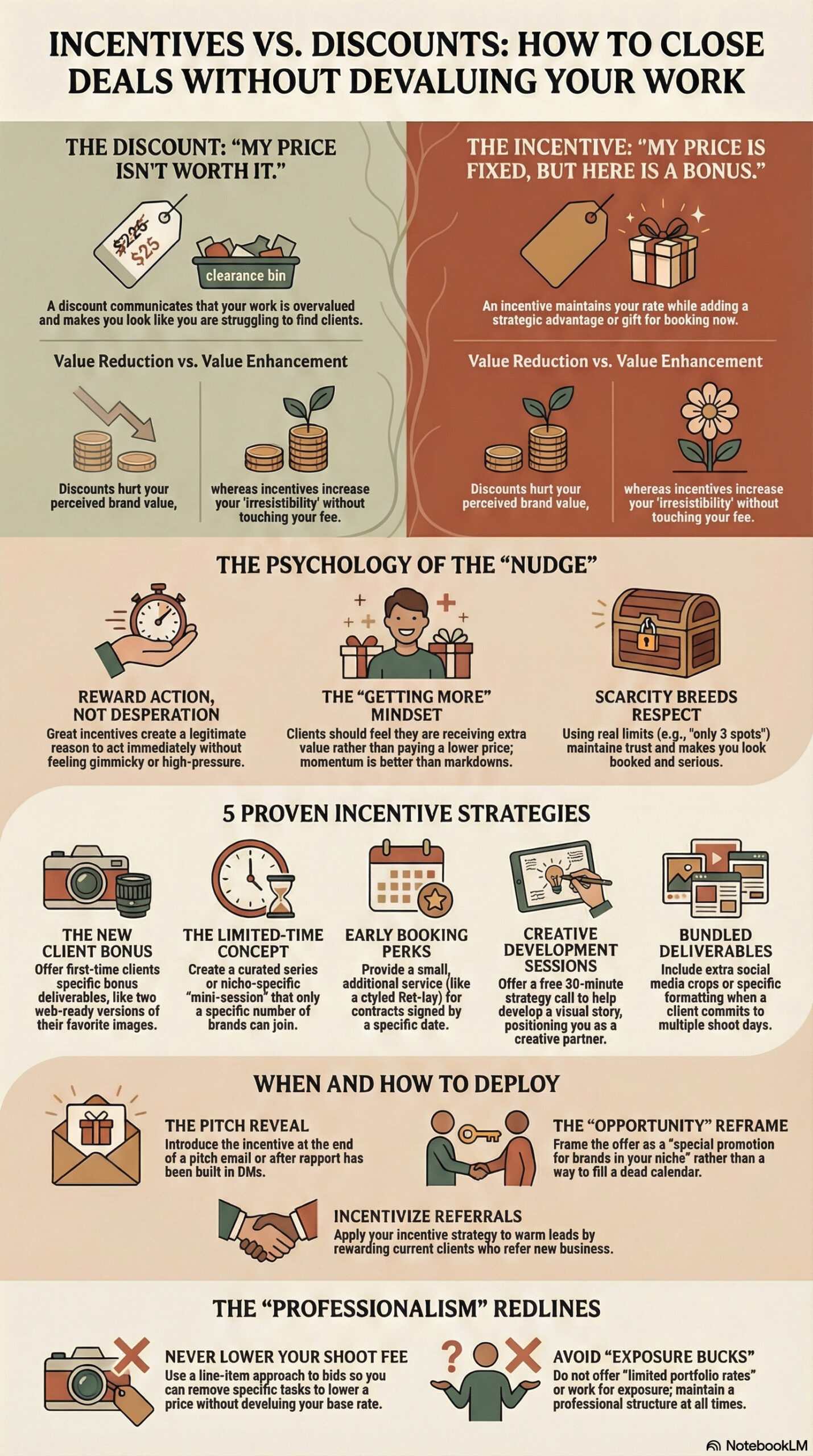
- A discount says: “My normal price isn’t worth it. Here’s a deal.”
- An incentive says: “This is my normal price, but here’s a bonus or advantage for booking now.”
The discount hurts your perceived value.
The incentive enhances it.
One makes you look like you’re struggling to get work.
The other makes you look like you have a process.
See the difference?
You’re not lowering your value; you’re increasing your irresistibility.
The Psychology of a Smart Incentive
Great incentives work because they:
- Create a reason to act now
- Feel customized or exclusive
- Offer real value without reducing price
- Don’t feel gimmicky
You want the client to feel like they’re getting more, not paying less.
Incentives are about momentum, not markdowns.
Incentive Ideas That Actually Work
Here are some proven ways to nudge clients toward “yes” — without ever saying “20% off.”
- New Client Bonus
“All first-time clients get two bonus web-res versions of their favorite image optimized and ready to use.” Why it works: Adds value. Costs you nothing but a few exports.
- Limited-Time Concept
“I’m shooting a series of tabletop images around sustainable skincare, only 3 brands will be included.”
Why it works: Creates scarcity and aligns with a niche. Feels curated.
- Early Booking Perk
“Book before [date] and I’ll include one styled flat-lay at no additional cost.” Why it works: Encourages quick decision-making and feels generous, not cheap.
- Creative Development Session
“With every new project booked this quarter, I’m offering a free 30-minute concept session to help you develop a strong visual story before we shoot.”
Why it works: Reinforces your value as a creative partner — not just a button-pusher.
- Bundled Deliverables
“When you book two shoot days in one month, I’ll deliver an extra set of cropped hero images for social, free.”
Why it works: Increases commitment and helps you control your calendar.
Positioning Is Everything
How you talk about the incentive matters more than the incentive itself.
Don’t say:
“Here’s a discount, I’m trying to fill my calendar.”
Say:
“This is part of a special promotion I’m offering to brands in [your niche]. It’s a way to show what I can do and create some beautiful, valuable work together.”
You’re offering an opportunity.
Not begging for a booking.
How to Introduce an Incentive (Without Feeling Awkward)
Timing is everything.
Introduce your incentive:
- At the end of your pitch email
- In a dedicated “announcement” post or story
- In your email newsletter
- In a DM after some rapport has built
And keep it low-pressure:
“If it’s helpful, I’m running a new client promo through the end of the month. No rush — just wanted to let you know in case it aligns with your plans.”
Simple. Confident. Professional.
Use Scarcity — But Keep It Honest
Scarcity works. But only if it’s real.
If you say “only three slots left” — mean it.
If you say “booking through Friday” — close it down Friday.
You’re not creating false pressure — you’re maintaining trust.
And believe it or not, clients respect structure. Boundaries make you look booked and serious, not desperate and scattered.
Bonus Tip: Incentivize Referrals, Too
Your incentive strategy isn’t just for cold leads — it works beautifully for warm ones, too.
Try this:
“If you refer a client who books, I’ll include a bonus image or a small shoot for you at no charge.”
Referrals are gold. Make them easy and rewarding.
Things to Avoid
Here’s what not to do when offering incentives:
- Don’t offer them too often (it kills urgency)
- Don’t lower your fee — ever — just to close a deal (Use a line item approach to the bid so you can cut from those lines without altering your shoot fee)
- Don’t complicate the offer (keep it clear and easy to say yes to)
- Don’t make it about you (“I need work”), keep it about them (“You get value”)
And please… no “exposure bucks” or “limited portfolio rates.”
You’re a professional. Act like it.
If you want to build your book, do it with strategic positioning.
We’re not playing amateur-hour pricing.
The Big Takeaway
Your rates are not the problem.
They never were.
There are clients who pay premium rates every day.
Because the see the value, and if the value doesn’t match the price in their heads, they are not interested in going forward.
So pricing is not the problem, but…
Your presentation might be.
Smart incentives give people a reason to move forward without making you look cheap.
They create urgency.
They increase value.
And most importantly, they help close the deal without damaging your reputation.
Your work is worth it.
Let the way you offer it reflect that.