
Where to Next
MEETING TIME FOR TODAY IS 12:30 PM PACIFIC
In a Nutshell
Elevate Phase Two: Building Market Momentum and Professional Systems
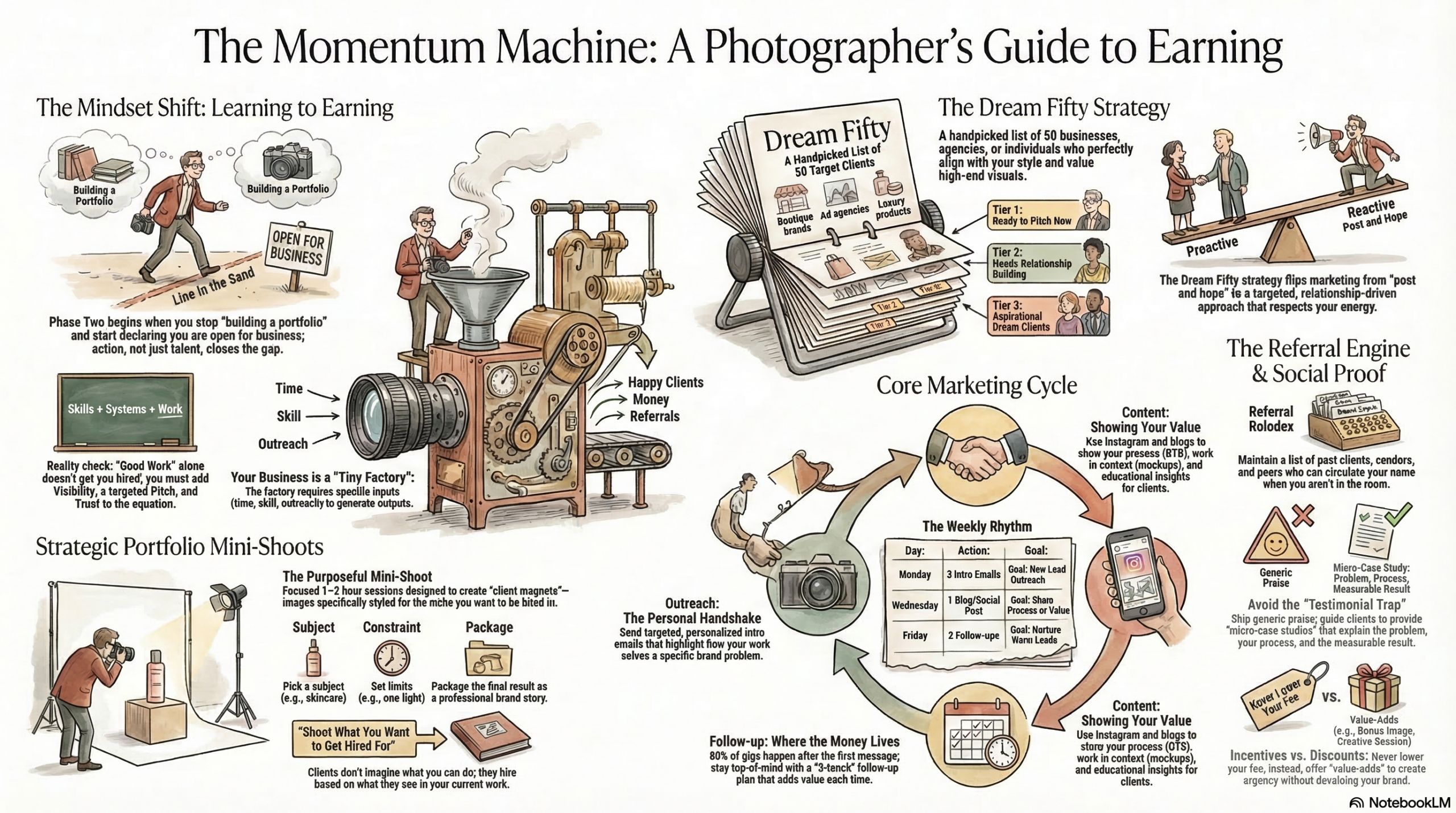
The transition from a photography hobbyist or student to a working professional is defined not by talent alone, but by the implementation of proactive systems and a fundamental mindset shift. The primary objective of “Phase Two” is to bridge the gap between “prep mode” and “paid work” by securing 3–5 assignments within a specific niche.
This phase rejects passive “discovery” in favor of ownership over outreach. It moves away from the “spray and pray” marketing model toward a targeted “Dream Fifty” strategy, supported by repeatable weekly habits and strategic personal projects. By treating a photography business as a “visual problem-solving factory,” creatives can build a sustainable pipeline that attracts high-value clients and creates long-term market momentum.
1. The Strategic Foundation: Niche and Identity
A central tenet of professional success is the move from being a generalist to a specialist. Generalists are often ignored because they force the client to do the work of figuring out if the photographer is a fit. Specialists, conversely, provide clarity that is “magnetic.”
The Niche Triangle
A viable niche exists at the intersection of three elements:
- Passion: What the photographer loves to shoot.
- Skill: Technical and stylistic strengths.
- Market Demand: What clients are currently paying for.
Positioning Statements
To communicate value quickly, photographers must use a clear positioning statement. A standard template involves: “I help [audience/industry] with [type of photography] so they can [specific benefit].”
Key Concept: Choosing a niche is not a “marriage” to a subject; it is building a bridge to paying clients. While a photographer can shoot multiple things, they must lead with one “front door” to avoid confusing the market.
2. Targeted Outreach: The “Dream Fifty” Strategy
The “Dream Fifty” is a curated list of 50 businesses, agencies, or individuals that are a perfect fit for the photographer’s style and values. This list allows for laser-focused marketing rather than wasting energy on irrelevant leads.
Tiered Lead Management
The list should be categorized into three tiers: | Tier | Description | Strategy | | :— | :— | :— | | Tier 1 | Ready to pitch now. | Direct outreach and immediate proposals. | | Tier 2 | Almost ready; needs warming up. | Relationship building and social engagement. | | Tier 3 | Aspirational “dream” clients. | Planting seeds through strategic personal projects. |
The 5-Part Intro Email Formula
A successful cold email must be a “handshake,” not a sales pitch. It should follow this structure:
- Human Greeting: Use the recipient’s name.
- The Hook: Mention their specific brand or a recent campaign to show research.
- Value Proposition: Explain how your work solves their specific visual problems.
- Proof: Provide a link to a curated, relevant set of images (no giant attachments).
- Call to Action (CTA): Suggest a low-pressure next step, such as a quick chat or portfolio review.
3. Systems Over Portfolios: The Weekly Rhythm
A portfolio is a proof of skill, but a system is a proof of business. To avoid the “feast or famine” cycle, photographers must commit to a Weekly Marketing Minimum, even when busy with assignments.
The Three-Part System
- Outreach: 3–5 new touches (emails, calls, DMs).
- Content: 2–3 pieces of public value (posts, behind-the-scenes, blogs).
- Follow-up: 2–3 touches with warm leads or past clients.
The Golden Rule of Follow-up: “Always add something.” Follow-ups should never be “just checking in.” Instead, they should provide a new piece of work, a relevant industry insight, or a creative idea for the client’s brand.
4. Strategic Content: Personal Projects and Mini-Shoots
Personal projects are “pre-client assignments” and the most effective marketing tool available. They prove the photographer can do the work they want to be hired for.
The 3 Criteria of a Marketable Project
- Relatable: It looks like the work target clients already hire for.
- Aspirational: It pushes beyond average quality in lighting and concept.
- Reusable: It generates multiple assets (BTS, lighting diagrams, case studies).
The Mini-Shoot Method
To build a portfolio quickly, photographers should use the Subject → Constraint → Package formula. These are 1–2 hour sessions with tight constraints (e.g., one surface, two props, one hour) designed to create “client magnets” rather than just pretty pictures.
5. The Digital Funnel: Instagram and Blogs
Digital platforms should be treated as strategic assets that guide a lead through a funnel:
- Top (Attention): Instagram posts and reels to build visibility.
- Middle (Engagement): Blogs and “behind-the-scenes” content that show how the photographer thinks.
- Bottom (Conversion): Clear CTAs on a website or in a portfolio.
Content Strategy
Photographers should rotate through four content pillars:
- Portfolio Highlights: The work they want more of.
- Behind the Scenes: Building trust and showing technical authority.
- Client Results: Testimonials and case studies.
- Educational/Insightful: Teaching or sharing insights that benefit the client.
6. Closing the Deal: Incentives and Testimonials
Securing the first 3–5 assignments often requires a strategic nudge.
Incentives vs. Discounts
The document makes a sharp distinction between these two:
- Discounts: Signal that the work isn’t worth its normal price; they devalue the brand.
- Incentives: Maintain the normal price but add a bonus (e.g., “New Client Bonus” of two extra web-res images or a “Creative Development Session”). Incentives increase “irresistibility” without looking desperate.
Story-Driven Testimonials
Generic praise like “Great to work with!” is ineffective. Powerful testimonials are micro-case studies that highlight:
- The Problem: The challenge the client faced.
- The Process: How the photographer brought clarity or expertise.
- The Result: Measurable outcomes (e.g., increased engagement or sales).
7. Operational Excellence: Tracking and Scaling
To move toward “Phase Three” (Mastery), photographers must track “momentum metrics”—leading indicators that predict future success.
Key Metrics to Track
- Pitches and Follow-ups sent.
- Personal projects completed.
- Conversations started and inquiries received.
- Lagging Indicator (The Result): Bookings made and total income.
30/60/90 Day Action Plan
- Days 1–30: Finalize niche, update website, send 20 intro emails, and set up a lead tracker.
- Days 31–60: Follow up with all warm leads, test a “new client” incentive, and execute another mini-shoot.
- Days 61–90: Analyze tracker, raise rates/repackage offers, and identify tasks to delegate or automate.
The path to becoming a “fully booked” professional requires transitioning from “chaotic hustling” to “focused building.” By implementing these systems, photographers stop waiting for permission to succeed and instead create a repeatable machine that generates both income and creative autonomy.
You’re not a hobbyist anymore.
Let’s build that momentum, and start getting paid for what you already know how to do.
Use this tool to generate an image and a critique. From beginner to advanced, these assignments will challenge and surprise you, and the critiques will make you think.
Get a good idea of what to charge for a variety of different photographic genres in areas like yours. Small town, mid-sized, or big city shooter, we have some ideas for you.
ARE YOU BEING PAID WHAT YOU ARE WORTH?
This is a tool to find out where you may be leaving money on the table, and undervaluing your work.
Our Next Meeting is in one month.
You must do this before attending:
- Send 60 emails minimum (3 per day Monday through Friday.)
- Talk to 6 clients one on one.
- Create 6 new portfolio pieces and be ready to share them.