
The Mentor's Corner
Business and Marketing for ProsIs Your Portfolio Ready for Tomorrow’s Meeting?
Building a Market-Ready Portfolio
A portfolio isn’t a scrapbook. It’s not a memory wall or a “greatest hits” reel. It’s your visual sales tool—the clearest expression of what you do, how you think, and why someone should hire you.
If Chapter 2 helped you define your niche, this chapter shows you how to prove it—with strategy, curation, and intent.
Your Portfolio Is a Business Tool
Your images don’t just need to be good—they need to be useful. To the viewer. To the client. To the job you want next. A market-ready portfolio isn’t about showing off, it’s about showing up—with work that says:
“This is what I do. This is who it’s for. And yes, I’m ready.”
Curate With Intention
Start with 20–30 images. That’s it. Every image should earn its place.
Ask yourself:
-
Can someone instantly tell what I specialize in?
-
Do these images look like they came from the same photographer?
-
Would a paying client want work like this?
Leave out the one-off experiments. Ditch anything that doesn’t align. Consistency beats variety. You’re not showing everything—you’re showing the right things.
Group Your Work Like a Buyer Would
Don’t make clients work to “get” you. Instead, organize your portfolio the way they think:
-
Product: Clean on-white shots, styled product scenes, or packaging in context
-
Food: Flat lays, plated dishes, restaurant environments, process shots
-
Lifestyle: Branded scenarios, natural moments, people interacting with products
-
Editorial: Story-driven imagery with a sense of narrative and place
Clear categories make it easier for clients to self-select—and for you to be taken seriously in your niche.
Show Range Without Losing Focus
Yes, clients want specialists. But they also want to know you’re versatile within your lane.
Let them see:
-
Bright daylight and dramatic controlled lighting
-
Studio cleanliness and on-location chaos
-
Detail shots and environmental context
Keep your visual language consistent—so even with variety, there’s a throughline of you in every frame.
Sequence Like a Story
Whether it’s a website, PDF, or print book—order matters.
-
Start strong. Lead with your best image.
-
Build rhythm. Mix wide and tight shots. Vary pacing.
-
End memorably. Your second-best image goes last—leave them with impact.
You’re not just showing work. You’re guiding a feeling.
Context Is a Multiplier
Add short captions where it helps. No fluff—just function.
“Shot for X brand’s spring campaign. Used in print, web banners, and point-of-sale.”
That context shows you’re client-ready. You think in deliverables, not just images.
No Client Work?
No Problem.
Make Your Own.
You don’t need to wait for permission to prove what you can do. Fill gaps with intentionally crafted personal projects.
-
Mock up a campaign for your dream brand
-
Style and shoot your favorite products as if hired
-
Create a photo essay for a magazine that doesn’t exist (yet)
If it solves a client problem and fits the brief—you’re already doing the work.
Format Like You Mean It
One portfolio isn’t enough. You need options:
-
Website: Clean, fast, and updated quarterly
-
PDF: Easy to send with cold pitches or follow-ups
-
Case Studies: For your blog, newsletter, or deck
-
Instagram: Not just pretty—aligned
Every platform is a handshake. Make sure your grip is solid.
Review Quarterly, Ruthlessly
Your portfolio is a living document. Set a date every quarter to:
-
Add new work that fits your direction
-
Remove anything that feels tired, off-brand, or below your current standard
-
Re-sequence for flow and relevance
You’re only as strong as your weakest image. Don’t let old work sabotage new opportunities.
Final Thought
A great portfolio doesn’t just get attention—it builds trust. It doesn’t say “look what I can do.”
It says, “This is exactly what you’ve been looking for.”
When you align your focus (Chapter 2) with your presentation (this chapter), you don’t just look professional. You are a professional.
Recent Business Posts

CREATIVE RISK AND PUSHING THROUGH
CREATIVE RISK AND PUSHING THROUGH At no time I can remember has the need to be able to deal with creative risk been more important than now. These times are unprecedented and the need for taking a risk even more important than it usually is. Creatives always face risk...

SO THIS IS DIFFERENT… WHAT’S NEXT?
What's Next? If that question was posed to some 'talking head' they would begin espousing information and data with a self assuredness that makes most of us feel inadequate at best. "Wow. That guy really knows his stuff." But he doesn't. Not really. No one knows what...

COUNTER-INTUITIVE APPROACHES TO THE “NEW NORMAL”
Approaching the "New Normal" I would say right off the bat that I hate that term, the "New Normal" as it makes it seem like something we volunteered for. And it wasn't.And it isn't. There is nothing 'normal' about these last 6 weeks. And there will not be anything...

CREATIVE APPROACHES TO WORKING THROUGH THE QUARANTINE
As most of the country is seeing the numbers falling back into a more manageable condition, we are seeing evidence of the impending reopening of the economy. Most states are looking at doing it in stages, and with controls in place to prevent a re-occurrence of the...
PHOTOGRAPHER GREG KINDRED HITS THE KANSAS CITY MARKET
Greg Kindred was the art director / photo editor for a large group of pet related magazines - both consumer and trade. When the company decided to close its doors, Greg realized it was time to do something else. Fast. The skills he had built up as a photographer are...
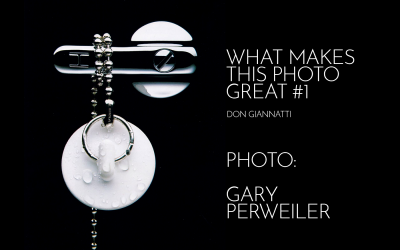
WHAT MAKES THIS PHOTO GREAT: EPISODE ONE, GARY PERWEILER
https://youtu.be/GzOWXPaO8P8

HOW TO STOP SELF SABOTAGE AND MOVE FORWARD IN THE NEW YEAR
THE MOST IMPORTANT STORIES WE WILL EVER HEAR COME STRAIGHT FROM OUR OWN MINDS. OVERCOMING SELF-FOCUSED NEGATIVITY 1. Have Daily Negative Thought Time A paradoxical strategy to gain control over negative thinking is to commit to 10 minutes a day ruminating and...

PHOTOGRAPHERS: CONCENTRATE ON THESE THREE THINGS FOR 2020
WHAT SHOULD PHOTOGRAPHERS FOCUS ON FOR 2021?VISIBILITY, DURATION, FREQUENCY As we slowly begin to let go of the miserable business climate most small businesses, creatives, photographers..., well, just about anyone in the creative arts community has had this past...

FIVE WAYS “IT’S JUST NOT FAIR”
Five Ways It’s Just Not Fair!(And Why You Should Stop Expecting It To Be) Have you ever felt that way or uttered those words in a state of anger, or disappointment, or jealousy? Perhaps you felt cheated or slighted. You worked all through the night on that science...
A SOCIAL MEDIA STRATEGY FOR A FICTITIOUS PHOTOGRAPHER
A SOCIAL MEDIA STRATEGY FOR A FICTITIOUS PHOTOGRAPHER My friend recently asked about what social media platforms work better for 'photographers' on Facebook? And that is a question a lot of commercial and editorial photographers are asking these days. In many cases...

STOP SELLING: WORK FOR A COLLABORATIVE COMMITMENT INSTEAD
It's sort of understood that creatives hate to 'sell'. It is an icky process that involves tricking people into purchasing stuff they don't need... as in used cars, or bathroom remodeling. Selling is akin to 'selling out', to becoming a slave to money, to ignoring art...