
Foundation and Lane Lock
Foundation and Lane Lock
This session resets how you think about commercial photography. We define what clients actually buy, establish the rules for building a professional portfolio, and lock in your Primary and Secondary lanes. From here on, every decision is intentional.
The $100K Side Hustle
5 Hard Truths About Making It in Modern Commercial Photography
The traditional studio model is dying, and the high-overhead dinosaurs are the last to know. In the “Shopify era,” speed and agility have replaced the bloated, slow-turnaround schedules of established firms. While traditional studios struggle to justify their massive lease payments and antiquated gear hauls, a new breed of photographer is dominating the market.
These are hobbyists with a backpack of gear, a single portable LED, and a relentless focus on commercial utility over artistic ego. They are out-earning traditional pros with 1/10th of the equipment because they understand that the Direct-to-Consumer (DTC) explosion requires constant, high-volume content, not a six-week production cycle. If you want to turn your gear into a $100K business, you must stop acting like a “starving artist” and start acting like a commercial asset.
Takeaway 1: The Two-Second Rule for Commercial Success
In commercial photography, the only metric that matters is legibility. If a client has to squint to figure out what you’re selling, you’ve failed. The “Two-Second Rule” dictates that a viewer must identify the subject immediately. This is not about being “dramatic”; it is about being useful.
Your images must pass a rigorous checklist: Is the frame calm and readable? Is there “brand-safe” space for text overlays or cropping? Most importantly, does the surface support the subject or compete with it? Amateurs often choose backgrounds that “look cool” but distract from the product. A professional uses a restrained color palette and clean shadows to ensure the product is the undisputed hero of the frame.
“Could a real business use this image without explanation?”
Pro-Mentor Analysis: Intent vs. Exploration The transition from amateur to professional is marked by the death of “exploration.” Amateurs go into a shoot to “see what happens.” Professionals go into a shoot with a predetermined intent. If you hesitate on whether an image is “finished,” it’s likely because you haven’t mastered the control required to deliver a predictable, commercial product.
Takeaway 2: The 70/30 Rule for Portfolio Discipline
A “jack-of-all-trades” is a master of none and a nightmare for clients to hire. To build credibility, you must adopt the 70/30 portfolio strategy. You must spend the first three weeks shooting your Primary Lane exclusively. Consistency is what earns your first paycheck; variety just creates confusion.
The Approved Lanes:
- Product / Still Life (70%):Focus on packaged goods, jars, and tools. This lane has the highest demand and the lowest logistics—you can shoot it on your kitchen table.
- Food / Beverage (70%):Focus on simple plated food and brand-neutral setups. Excludes: Restaurant interiors, people-heavy scenes, and lifestyle chaos. This is about the plate, not the vibe.
- B2B Detail & Brand Assets (70%):Focus on hands at work, textures, and materials.
Your Secondary Lane (30%) is introduced only after you’ve proven consistency.
If the second lane feels like a “genre switch,” delete it.
Pro-Mentor Analysis: The Power of Easy Substitution The reason we prioritize Product and Food is “easy client substitution.” These niches allow for a predictable workflow that is easy to systemize. By mastering one lane, you remove the friction of “figuring it out” every time a new client calls, allowing you to scale your income without scaling your stress.
Takeaway 3: Why “Clear” Beats “Clever” Every Single Time
The biggest trap for a developing photographer is the urge to be “clever.” Experimental lighting, extreme contrast, and complex visual metaphors are usually “out of sequence” for someone building a side hustle.
The requirement for mastery is a brutal assignment: Two images. Same subject. Same setup. Same surface. Same light. You are not allowed to change the props or the concept. You are only allowed to refine.
“Clients don’t buy clever first. They buy clear.
This is commercial training, not therapy.”
Pro-Mentor Analysis: Control Before Creativity Success in this assignment is binary: If Image Two isn’t better than Image One, slow down. You must prove you can control a single light and a single surface before you earn the right to experiment. Mastery of basics is significantly more profitable than unguided “personal project” logic.
Takeaway 4: The Surprising Math of the Weekend Photographer
The 2025 market rates prove that you don’t need a 40-hour workweek to hit six figures. Because DTC brands need fresh content weekly for TikTok and Instagram, recurring revenue is the new standard.
2025 Market Rates:
- Product Photography: $300 per image.
- Food Photography: $500 per hour.
- Lifestyle/Brand Content: $1,500 – $2,500 per half-day shoot.
The Side Hustle Math:
- Conservative (5–10 hours/week):2 small product shoots and 1 food session = 3,500/month.
- Aggressive (15–20 hours/week):4 product shoots and 2 lifestyle shoots = 100K+ annually).
The Three Money-Making Niches:
- Product:
Serve Amazon and Shopify sellers who need white-background and lifestyle context shots. Logistics: Shoot at home in 1–2 hour blocks. - Food:
Help local restaurants with menu updates. Pro Tip: Partner with a food stylist (60/40 fee split) to command higher rates. Restaurants often book evening shoots, perfect for side-hustlers. - Lifestyle/Brand:
Create content libraries for coaches and wellness brands. Logistics: Higher price per shoot ($2,000+) with quarterly recurring revenue.
Pro-Mentor Analysis: The DTC Recurring Revenue Model The “DTC explosion” has changed the game from “one big shoot” to “many small batches.” By systemizing your workflow and shooting at home or during restaurant off-hours, you create a high-margin business that fits into the gaps of a 9-to-5.
Takeaway 5: The Mobile Studio Revolution
The high-overhead studio is a liability, not an asset. Modern commercial photography is powered by lightweight mirrorless cameras and portable LEDs—a “mobile studio in a backpack.” High-end, expensive gear experiments are “out of sequence” for the side-hustler; use what you know and keep your overhead near zero.
Cloud storage and online editing allow you to work from anywhere, providing the “faster turnaround” that modern clients crave. In the Shopify era, flexibility is the ultimate currency. The ability to shoot on-location or in a small home setup and deliver polished files within 48 hours makes you more competitive than any traditional studio.
Pro-Mentor Analysis: Agility as an Asset Traditional studios are slow. They have “creative directors” and “studio managers” who add friction. As an agile side-hustler, you are the photographer, the editor, and the point of contact. This lean structure isn’t just a way to save money—it’s your primary competitive advantage in a market that values speed over spectacle.
Your First Step Toward Control
Commercial photography is not about adding complexity; it is about minimizing distraction. It is a discipline of execution and intentionality. If you want to build a $100K side hustle, you must trade your “artistic ego” for “commercial utility.”
If you stripped away the “clever” metaphors and artistic ego, what is the one clear, commercial subject you could master in the next three weeks?
The $100K Side Hustle Module One Overview
Meeting Notes
Quick recap
The meeting served as an introductory session for a photography class, where Don introduced the new homepage and recording system while participants shared their backgrounds and reasons for joining. Don discussed the impact of COVID on the photography industry and emphasized the class’s focus on commercial photography, including guidelines for a photography side hustle and equipment recommendations. The session concluded with discussions on marketing strategies for photographers, emphasizing the importance of contacting potential clients through various channels and using AI tools for client research.
Next steps
- All participants: Choose your primary and secondary “lanes” (specialization areas, e.g. food, product, etc.) for the class and begin working on relevant shots for your chosen lane.
- All participants: Complete up to 5 images for the first assignment, resize to 1200 pixels on the longest side, name files according to the specified format (S_Lastname-Firstname_Module#-
1/2/3/4/5), and upload to the class page before next Saturday. - Don: Fix the upload instructions on the class page to clarify the 1200 pixel limit and file naming convention.
- Don: Create a Facebook group for the class and post the link on the class page.
- Don: Post links and passwords for the “One Big Light” class, “Find Photo Clients Now” class, and the AI/client-finding workshop on the class page.
- Don: Post prompts and resources for using Perplexity and Abacus AI tools, including example prompts for client searches, on the class page.
- Don: Post the link to the GenSpark AI tool and related information on the class page.
- All participants (optional, but encouraged): Set up a dedicated shooting area at home if possible, and acquire necessary equipment (C-stand/boom, softbox, scrim, foam boards, sturdy tripod) as discussed.
- All participants: Begin identifying and listing potential local clients in your chosen lanes using Google Maps and AI tools as demonstrated.
- All participants: Start preparing for the email outreach program (beginning week after next) by reviewing provided scripts and considering potential clients to contact.
- Don: Post the schedule and Zoom link for the Tuesday evening class meetings on the class page.
- All participants: Submit images for review before the next class session (by next Saturday).
Summary
Commercial Photography Class Introduction
The meeting served as an introductory session for a photography class, where Don introduced the new homepage and recording system for the class. Participants shared their backgrounds and reasons for joining the class, which included a mix of professionals looking to transition into commercial photography, such as Debra Mercaldo, Mike Collins, and Rick Bougiet. Don emphasized the flexibility of the class and its focus on commercial photography, distinguishing it from previous projects like Project 52. The session concluded with an overview of the class structure and a brief discussion about the transition to the new homepage and recording system.
COVID’s Impact on Photography Industry
Don discussed the impact of COVID on the photography industry, noting a shift from traditional studio setups to more flexible arrangements, particularly for photographers working with smaller clients and startups. He emphasized that this class focuses on directing clients for side hustle opportunities rather than securing jobs through ad agencies. Don highlighted the growing demand for photography in AI-driven advertising and suggested that photographers can earn a reasonable income from part-time work, cautioning against overly optimistic financial projections.
Photography Specialization and Focus Strategy
Don discussed the shift in the photography industry, noting the decline in studio usage and the focus on delivering clean, simple images that meet client needs. He emphasized the importance of specializing in two main areas, referred to as “lanes,” with 70% focus on a primary lane and 30% on a secondary lane. Don encouraged participants to choose their lanes for the week and highlighted that while they can still take on diverse photography tasks, the class will focus on delivering technically perfect and stylistically appropriate images.
Photography Side Hustle Guidelines
Don discussed the guidelines for a photography side hustle, emphasizing market-appropriate work and efficient production. He explained file naming conventions and image size requirements for submissions. Don encouraged participants to focus on their chosen lane for the first three weeks and submit up to five images per week for review. He also mentioned upcoming discussions on rates and reminded everyone to bookmark the new homepage for resources and information.
Photography Class Preparation Tips
Don advised Matthew to choose photography lanes based on skills and interests rather than market demand, noting a strong market for photography across various platforms. Don discussed the equipment needed for the class, emphasizing the importance of a normal lens, a scrim, a softbox, and a boom arm, and suggested using folding tables for shooting. He also mentioned a second meeting time on Tuesday evening for those who couldn’t attend the Saturday morning session, and encouraged participants to set up a dedicated shooting space at home.
Class Photography Business Strategies
Don discussed creating a Facebook group for the class and shared equipment recommendations, including Amazon Basics stands and foam core boards from Target. He mentioned a previous lighting class called “One Big Light” that Luciano found helpful. Don also shared his experience with getting photography business through direct mail and email outreach, emphasizing the importance of making 4 client contacts per day to generate work. The class will start an email program in the coming weeks, using provided scripts to reach out to potential clients.
Photographer Marketing Strategies Meeting
Don led a meeting about marketing strategies for photographers, emphasizing the importance of contacting potential clients through email, direct mail, and in-person networking rather than cold calling. He discussed the use of AI tools like Perplexity and Abacus for finding client information, and recommended the use of phone photography for restaurant marketing. Don also advised photographers to identify their target clients and market to them effectively, suggesting the use of LinkedIn and other networking opportunities. The conversation ended with a discussion of upcoming classes and the use of AI tools for client research.
MODULE ONE-B
Course Details
Module
One-A / Foundation and Lane Lock
Summary:
Changing Mindset from Hobbyist to Professional / Assignment One
Image Upload:
|
Upload files
|
|
|
|
|
|
|



|
|
Image Size: 1200 pixels on long side
IMPORTANT: IMAGE FILE NAME
SH-first-last-module-#
(Like this: SH-don-giannatti-module-1)
Shot Ideas for Food Shooters
10 Kitchen-Studio Shots for a Food Photography Side Hustle
Hero Plate (Straight-On)
One finished dish.
Simple background.
Light from the side or back.
Purpose: Can you make food look like food?
Hero Plate (45° Angle)
Same dish, new angle.
Slight depth, controlled shadows.
Purpose: Menu and website utility.
Ingredient Flat Lay
4–6 raw ingredients used in the dish.
Clean spacing, neutral surface.
Purpose: Farm-to-table, brand storytelling.
Prep Moment
Hands slicing, sprinkling, plating.
No face. No chaos.
Purpose: Process sells trust.
Detail Shot
Tight crop: texture, sauce, crust, steam.
Shallow depth optional.
Purpose: Sensory trigger.
Vertical Crop for Social
Same dish, framed tall.
Negative space at top or bottom.
Purpose: Client-ready flexibility.
Minimal “Brand” Shot
Dish + linen + simple prop (fork, napkin).
Nothing extra.
Purpose: Shows restraint (rare skill).
Dark Plate / Light Food
High contrast setup.
Control spill, watch edges.
Purpose: Mood without gimmicks.
White Plate / Light Background
Clean, bright, honest.
Soft shadows.
Purpose: Editorial and commercial crossover.
Wide Context Shot
Table edge, partial environment.
Still controlled. Still quiet.
Purpose: Tells a story without yelling.
Shot Ideas for Product Shooters
10 Kitchen-Studio Product Shots (Side Hustle Edition)
Pure Catalog Shot (White or Light Neutral)
One product, centered.
Soft side or top light.
Clean shadow, no drama.
Purpose: Baseline competence. Non-negotiable.
45° “E-commerce” Angle
Same product, slight perspective.
Shadow adds depth, not mood.
Purpose: Amazon, Shopify, websites.
Straight-On Hero
Label perfectly square.
Camera level with product.
Purpose: Brand authority shot.
Detail Close-Up
Texture, label, cap, stitching, surface.
Sharp where it matters.
Purpose: Tactile credibility.
Product + One Supporting Prop
ONE prop. Not a scene.
Related, not decorative.
Purpose: Context without clutter.
Dark-on-Light or Light-on-Dark Contrast
Control spill.
Watch edges like a hawk.
Purpose: Visual punch for ads.
Negative Space Version
Product pushed left or right.
Clean breathing room.
Purpose: Copy placement = client gold.
Vertical Crop
Same setup, reframed.
Keep proportions honest.
Purpose: Social + stories.
Lifestyle-Hint Shot
Product in use or implied use.
No faces. No chaos.
Purpose: Suggests value without staging a movie.
Series Consistency Shot
Same product, same light, slight variation.
Or two SKUs, matched perfectly.
Purpose: Shows you understand systems, not just single images.
Shot Ideas for Branding and Liftestyle Shooters
10 Lifestyle / Branding Shots (No People)
Product in Environment
Product placed where it belongs.Counter, shelf, table edge.
Purpose: Context without explanation.
Morning Light Scene
Soft side light.
Suggests time of day, not a story arc.
Purpose: Mood brands can reuse.
Workspace Flat Lay
Tools, materials, product.
Clean spacing, intentional gaps.
Purpose: Brand competence.
Detail-in-Context
Close-up with background falloff.
Texture + environment.
Purpose: Feels lived-in, not staged.
Negative Space Brand Frame
Subject anchored to one side.
Lots of breathing room.
Purpose: Designed for copy.
Texture + Object
One surface, one object.
Light sculpts both.
Purpose: Tactility sells.
Color-Controlled Scene
2–3 colors max.
Nothing accidental.
Purpose: Shows art direction.
Overhead Environmental Shot
Not cluttered.
Not decorative.
Purpose: Web headers, social.
Wide Establishing Shot
Pull back just enough.
Edges clean, lines deliberate.
Purpose: Brand storytelling without words.
Series Anchor Shot
The image everything else relates to.
Same light, same palette.
Purpose: Proves this isn’t random.
Course Content
Introduction
Foundation & Lane Lock
Theme: You Are Building a Commercial Asset
CLASS OBJECTIVE (INVISIBLE BUT CRITICAL)
By the end of this session, students should:
-
Stop thinking like hobbyists
-
Understand the rules of the game
-
Commit to a narrow, defensible direction
-
Leave knowing exactly what to shoot this week
If they feel slightly constrained but relieved—you nailed it.
THE COMMERCIAL RESET
Photography is our tool to create what clients need.
1. What Clients Actually Buy
-
Reliability
-
Consistency
-
Usability
-
Taste (quiet, not flashy)
Clients are not buying:
-
Your struggle
-
Your gear
-
Your passion
-
Your range
They buy risk reduction.
2. The Difference Between Shooting and Producing
-
Shooting = expression
-
Producing = problem solving
This course is about producing.
THE TWO-LANE SYSTEM
The Rule
-
One Primary Lane (70%)
-
One Secondary Lane (30%)
-
No third lane
-
No improvising lanes later
Approved Lanes (Repeat Them Verbally)
-
Product / Still Life (tabletop)
-
Food / Beverage (controlled)
-
B2B Detail / Brand Assets
Explain why these lanes:
-
Low logistics
-
High demand
-
Fast credibility
-
Portfolio-friendly
“Constraints don’t limit you. They get you hired.”
PORTFOLIO RULES (GUARDRAILS)
This prevents 80% of bad habits.
Non-Negotiables
-
Market-appropriate always
-
No experimental lighting
-
No stylization that limits usage
-
No props that distract
-
No “I just wanted to try something”
Say this clearly:
“If a client can’t immediately imagine using it, it doesn’t belong here.”
What a “Good First Image” Looks Like
-
Clear subject
-
Controlled light
-
Neutral surface
-
Predictable composition
-
No gimmicks
Not exciting. Credible.
ASSIGNMENT BRIEF (VERY SPECIFIC)
This is where confidence is built.
WEEK 1 PORTFOLIO ASSIGNMENT
You must create:
-
Two images
-
Same subject
-
Same setup
-
Same light
-
Primary lane only
The goal:
Improve execution, not concept.
Allowed changes between images:
-
Micro-composition
-
Minor light refinement
-
Small exposure adjustments
Not allowed:
-
New props
-
New concepts
-
New styles
Included Resources
Resource Links & Facebook
The Deep dive Podcast
Lane Lock / Criteria Review
Assignment Dos and Don'ts
Module One PDF
Requirements
You should have a place to shoot on a surface: kitchen, spare bedroom, or heated/cooled garage.
Gear:
Camera and normal lens (50 mm on a full-frame). A wide-angle and a short telephoto should follow.
Lighting: A large scrim/softbox with something to hold the scrim.
Three stands (cheap are fine)
One good boom (C-Stand is preferable for footprint, but a wall mounted boom works well too.
A selection of white foam boards; even better to make a couple of them black on one side.
a tether cable for shooting into a computer.
A sturdy tripod.
WHY THIS IS HOT RIGHT NOW
The E-Commerce Explosion
- Every Shopify store, Amazon seller, and Instagram brand needs constant visual content
- DTC (Direct-to-Consumer) brands are multiplying—they ALL need product & lifestyle shots
- Social media platforms demand fresh, high-quality content weekly (not just one-time shoots)
- TikTok Shop & Instagram Shopping are driving massive demand for lifestyle product photography
The Death of Traditional Studios
- You can shoot anywhere: home setups, client locations, outdoor spaces
- Lightweight mirrorless cameras + portable LED lighting = mobile studio in a backpack
- Cloud storage + online editing = work from anywhere
- Clients expect flexibility and faster turnaround (perfect for side hustlers!)
INCOME POTENTIAL: THE REAL NUMBERS
Pricing Breakdown (2025 Market Rates)
| Service Type | Beginner Rates | Experienced Rates | Premium Rates |
|---|---|---|---|
| Product Photography (per image) | $50-$150 | $150-$300 | $300-$800 |
| Food Photography (hourly) | $100-$300 | $300-$500 | $500-$1,000+ |
| Lifestyle/Brand Content (half-day) | $800-$1,500 | $1,800-$2,500 | $2,500-$5,000 |
| Full-Day Shoot | $1,200-$2,000 | $2,300-$3,500 | $4,000-$10,000+ |
Package Examples from Real Photographers:
- Starter Package: 10 product images, 1-hour shoot, light editing = $500-$1,500
- Standard Package: 20 images, 2-hour shoot, styling included = $1,500-$3,000
- Premium Package: 30+ images, full-day shoot, advanced retouching = $3,000-$5,000+
Side Hustle Math:
Conservative Scenario (5-10 hours/week):
- 2 small product shoots/month @ $800 each = $1,600/month
- 1 food photography session @ $1,200 = $1,200/month
- Total: $2,800-$3,500/month working weekends/evenings
Aggressive Scenario (15-20 hours/week):
- 4 product shoots @ $1,200 = $4,800
- 2 lifestyle shoots @ $2,000 = $4,000
- Total: $8,800+/month = $100K+ annually as a “side hustle”
THE THREE MONEY-MAKING NICHES
1. PRODUCT PHOTOGRAPHY
Best For: E-commerce brands, Amazon sellers, Etsy shops, Shopify stores
What They Need:
- White background shots (Amazon/marketplace requirements)
- Lifestyle context photos (Instagram, Facebook ads)
- Detail/close-up shots (texture, features, quality)
- 360° spin shots (emerging trend)
Client Types:
- Small business owners launching products
- Established brands refreshing their catalog
- Subscription box companies (recurring work!)
- Dropshippers who need custom shots
Why It Works as a Side Hustle:
✅ Shoot at home with simple setup (white backdrop + lighting)
✅ Can be done in 1-2 hour blocks
✅ High volume potential (batch shooting = efficiency)
✅ Predictable workflow (easier to systemize)
2. FOOD PHOTOGRAPHY
Best For: Restaurants, meal prep services, food brands, cookbooks, food bloggers
What They Need:
- Menu photography (restaurants updating online presence)
- Social media content (Instagram-worthy shots)
- Packaging photography (food brands)
- Recipe/cookbook photography
Client Types:
- Local restaurants (HUGE market—every restaurant needs updated photos)
- Food delivery services (GrubHub, UberEats listings)
- Meal kit companies
- Food bloggers building their brand
- Beverage companies (craft beer, coffee, cocktails)
Why It Works as a Side Hustle:
✅ Shoots typically 2-4 hours (doable on weekends)
✅ Restaurants often book evening shoots (perfect timing!)
✅ High repeat business (menu updates, seasonal dishes)
✅ Can charge premium for food styling skills
Pro Tip: Partner with a food stylist (split fee 60/40) to command higher rates without doing styling yourself.
3. LIFESTYLE/BRAND PHOTOGRAPHY
Best For: Personal brands, coaches, small businesses, wellness brands, fashion
What They Need:
- “Founder story” content (authentic behind-the-scenes)
- Product-in-use lifestyle shots
- Social media content libraries (20-50 images per shoot)
- Website hero images and About page photos
- LinkedIn/professional branding shots (NOT traditional headshots)
Client Types:
- Coaches, consultants, solopreneurs building personal brands
- Small retail businesses (boutiques, salons, gyms)
- Wellness brands (yoga studios, health products)
- Real estate agents (lifestyle branding, not property photos)
- Fashion/jewelry designers
Why It Works as a Side Hustle:
✅ Higher prices per shoot ($2,000-$5,000 range)
✅ Can shoot at client’s location or trendy public spaces
✅ Clients need content quarterly (4x/year recurring revenue)
✅ More creative freedom (portfolio-building)
STARTING NOW
CLIENT ACQUISITION STRATEGIES
High-Converting Methods for Side Hustlers:
1. Instagram Portfolio + Hashtags
- Post your best work 3x/week
- Use local + niche hashtags (#ChicagoFoodPhotography, #ProductPhotographyLA)
- Engage with potential clients (comment on restaurant/brand posts)
- ROI Timeline: 2-3 months to first client
2. Direct Outreach (Fastest Results)
- Find businesses with bad photos on Instagram/website
- Send personalized DM: “Hey [Name], love your [product]! Noticed your photos could use an upgrade—I specialize in [niche]. Mind if I send you some examples?”
- Offer first shoot discount (50% off) to build portfolio
- ROI Timeline: 1-4 weeks to first client
3. Local Business Networking
- Join Chamber of Commerce or BNI group
- Attend food festivals, farmers markets (meet food brands)
- Partner with complementary services (web designers, marketers)
- ROI Timeline: 1-2 months
4. Freelance Platforms (Quick Side Income)
- Upwork, Fiverr, Thumbtack for product photography
- Set competitive intro pricing, build reviews
- Transition high-value clients off-platform
- ROI Timeline: 1-2 weeks
5. Content Marketing
- Start YouTube/TikTok showing behind-the-scenes of shoots
- Share “before/after” transformations
- Create value content (“5 Tips for Better Product Photos”)
- ROI Timeline: 3-6 months (longer but scales)
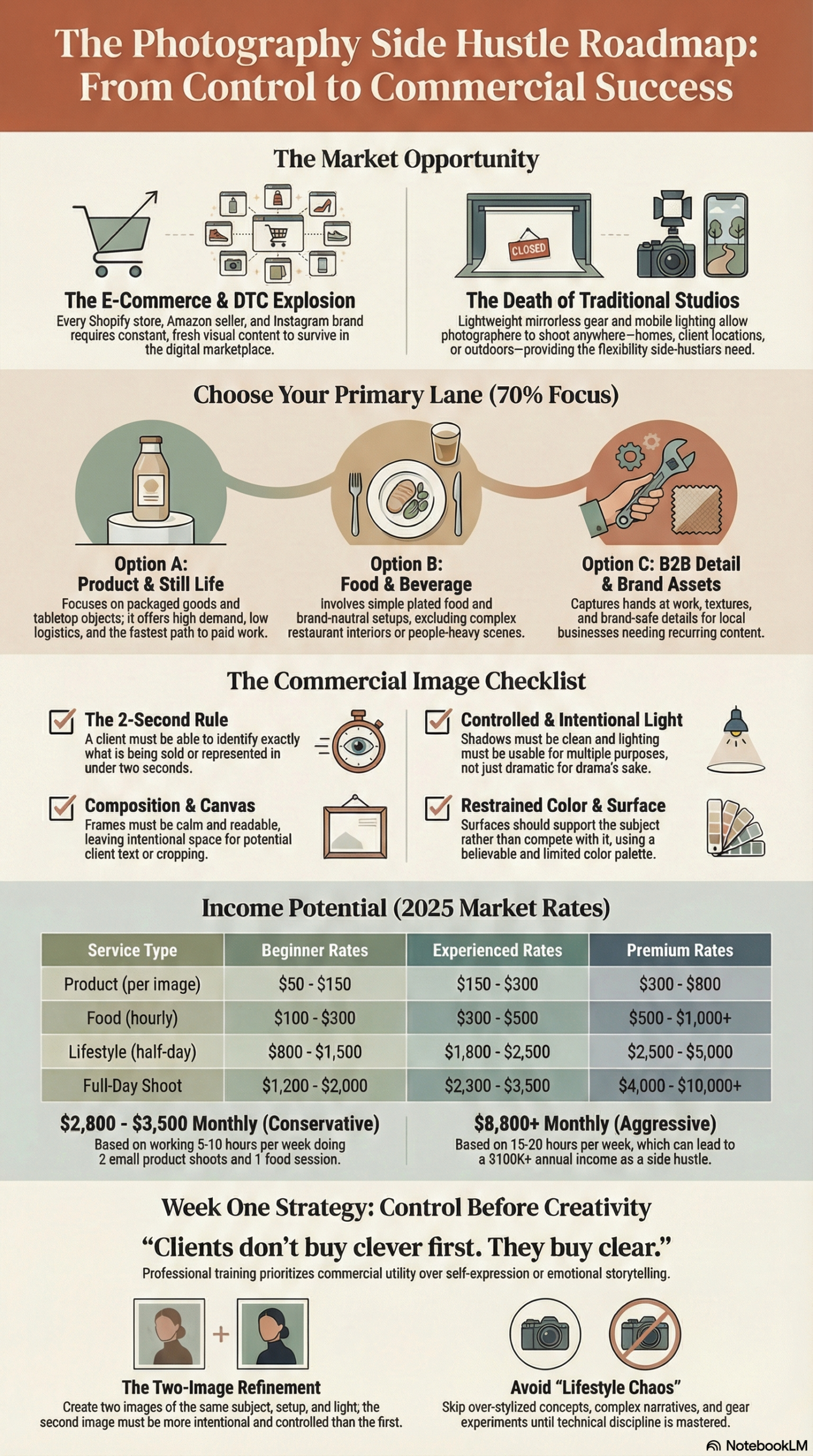
Download this and print it out.
Put it where you can see it every day.
Meeting Notes
Quick recap
The meeting focused on reviewing photography assignments and discussing home studio setup strategies. Don provided feedback on students’ product and food photography work, emphasizing the importance of controlling light and creating consistent branding. He shared tips on using scrims and softboxes to achieve desired lighting effects. The group discussed finding clients and creating a home studio on a budget, with suggestions to source materials from Home Depot, Lowe’s, and Habitat for Humanity. Students were encouraged to start building their portfolios immediately and not to wait until everything is perfect. Don introduced the concept of a 14-day plan to get a photography business started. The conversation ended with students choosing their main photography lanes, with most opting for a combination of product and food photography.
Next steps
- All participants: Wait until Wednesday to upload photos for the class to avoid mixing with other classes
- All participants: Name image files with “SH – first name – second name – number” when uploading to class gallery
- Mike Collins: Rename previously uploaded images to include proper naming convention
- All participants: Complete next assignment – shoot 5 different objects in kitchen studio
- All participants: Be prepared to discuss their home studio setup and plans in next class
- Scott: Visit local keto snack store and restaurant to discuss potential photography opportunities
- LucianaRizzi: Follow up with Don separately to discuss focus/lanes for her photography work
- All participants: Review Module B on finding clients
- All participants: Review 14 day plan template for getting business started
- All participants: Choose their primary and secondary “lanes” (focus areas) for their photography work
- All participants: Review lighting videos linked in the workshop home page (right-hand column) as assigned by Don
- All participants: Review One Light class materials before next session
- Don: Set up links to 2 more additional classes for participants to access
- Don: Get Starlink internet service (mentioned as personal action, but explicitly stated as next step)
Summary
Photography Lighting Techniques Overview
The group discussed their progress on a photography assignment focused on one-light setups. Don emphasized the importance of understanding how light behaves as objects are moved closer or farther away, explaining the inverse square law. He encouraged students to experiment with different setups while keeping it simple. Luciana shared her photos, which showed good understanding of lighting techniques. Don praised her work and explained the concept of getting multiple shots from one setup. He advised students to upload their photos by Wednesday to avoid mixing with other classes. Don also mentioned he would provide links to additional classes, including a still life course, to help students further their skills.
Product Photography Review and Feedback
The team reviewed and discussed various product photography images, focusing on lighting setups and post-processing techniques. Becky and Mike presented their photos, which Don provided feedback on, including suggestions for improving contrast and adding gradient effects. The group also discussed naming conventions for image files and the importance of maintaining consistent file organization. Don emphasized the need to provide clients with a variety of images to keep their social media pages fresh and engaging.
Product Photography Lighting Techniques
The team discussed photography techniques for product shots, focusing on background removal and lighting. Mike shared his experience with shooting on white backgrounds and using AI fill tools, while Don provided tips on using negative fill cards and content-aware fill. Mac presented two mug shots and asked about focus, which Don confirmed was acceptable. The discussion emphasized the importance of sharp edges and proper lighting for product photography, with Don recommending apertures of F8 or higher for optimal results.
Product Photography Lighting Workshop
Don led a photography workshop where participants captured product shots using various lighting techniques. He emphasized starting with lights close to the subject and gradually moving them back, explaining the inverse square law’s impact on exposure. Participants shared their photos, including Debra’s wine stopper shots and Debra’s and Patrick’s Deserrano bottle images. Don provided feedback on lighting setups, color consistency, and background choices, advising to shoot with extra space for flexibility and to consider clients’ intended uses for images.
Home Studio Setup and Tips
Don discussed setting up a home studio, emphasizing the importance of controlling light and mood to meet client needs. He shared tips on using AI-generated images, managing time, and creating a portfolio with simple shots. Don highlighted the 90% rule, suggesting that 90% of table shots can be done with one light. He also advised on finding props, such as kitchen appliances and musical instruments, and using surfaces like tiles from Home Depot for shoots. Don encouraged participants to start networking and building a client base immediately, rather than waiting until their portfolio is complete. He concluded by discussing the benefits of writing a book or creating a portfolio in small, manageable steps.
Food Photography Focus and Lighting
The group discussed lighting techniques using scrims and Octoboxes, with Don explaining how to create different lighting effects by varying the distance between the light source and scrim. Students then chose their focus areas for the next assignment, with most selecting food photography as their primary lane and product photography as their secondary lane, though some like Mike Collins and Scott focused primarily on products due to time constraints. Don encouraged students to explore creative food photography ideas, mentioning Judy’s successful approach of photographing food truck meals both in their original packaging and styled on plates.