MOTION
We Are Gonna Get Movin’
Motion is the New Visual Currency
Art directors are not being subtle about it anymore. If your portfolio has no motion, some of them will not look past the first page. That is not a trend to watch. It is a door closing, and it is closing now.
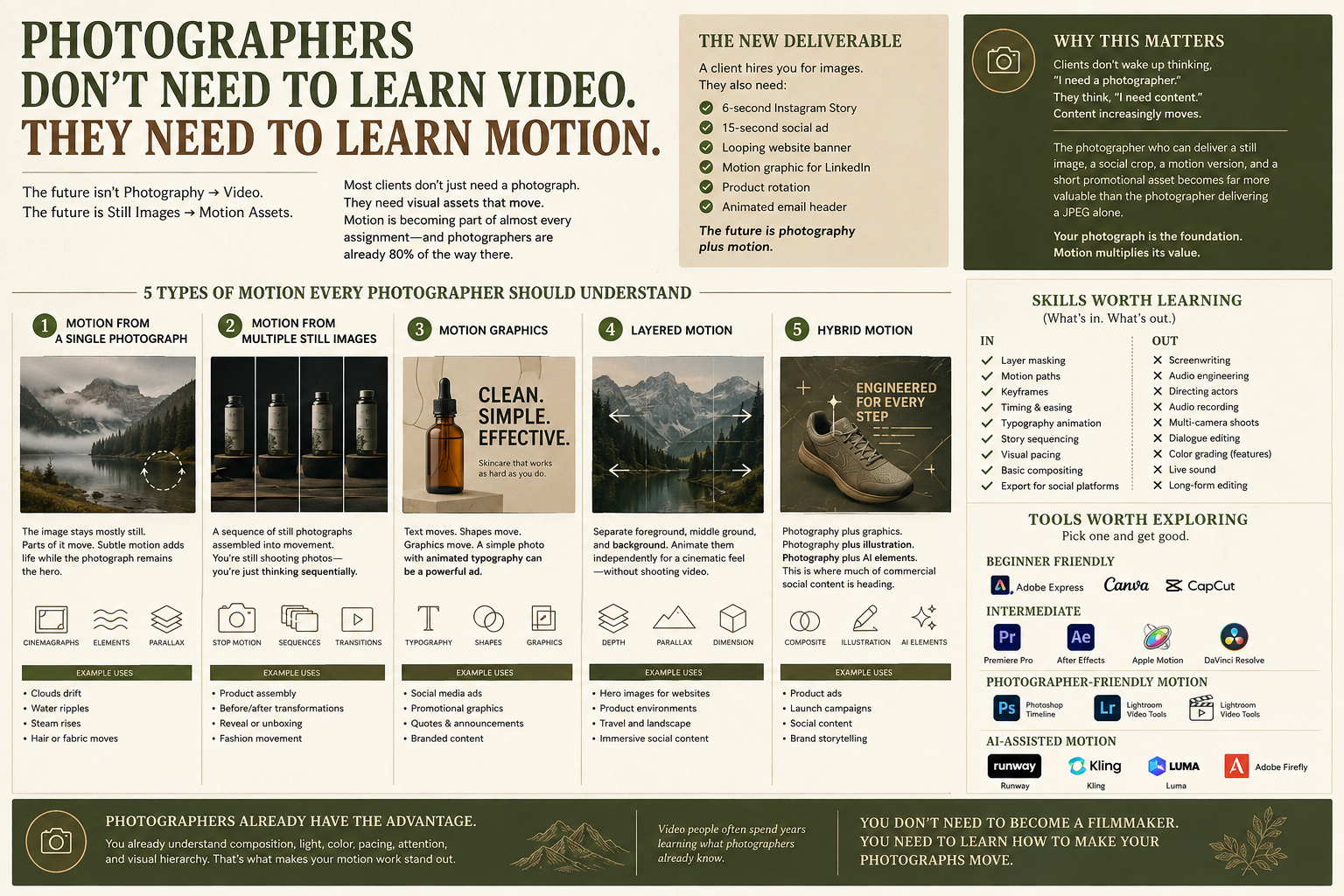
This eight-week live workshop is built for photographers who already know how to shoot. We are not starting from scratch on exposure or composition. We are taking what you already do well and adding the one thing your portfolio is missing. Stop motion, short video clips, cinemagraphs — the kind of motion work that lives on a portfolio page and makes a client stop scrolling. Six finished, portfolio-ready pieces in eight weeks. Live on Zoom every Saturday morning, with recordings, PDFs, a private peer review group, and direct critique from someone who has shot commercially for over 55 years.
We will create images that can be moved in every way possible to find out how to work with the many styles of motion.
And yes, we will be exploring the various ways AI can be used to animate still works. No subscription is needed; the free versions will be fine.
You will need the following:
Tripod.
Continuous light (even window light)
Cards.shiny boards, and surfaces to shoot on.
A camera that shoots video.
Software: LR/Photoshop/Canva (iMovie if you are on Mac is helpful.)
We are not going to get into DaVinci Resolve… Although I will post some good info for you who may be interested.
We are going to be focusing on creating motion, sequencing, stop motion, and motion graphics used with photography/video clips.
I want you to shoot a lot of video/motion work, so be prepared and stay excited.
NOTE: NEW MEETING TIME:
7:30 AM.
LINK IS ON THE CLASS PAGE.
PASSWORD WILL BE GIVEN AT THE MEETING.
Not what we are doing, but look at the possibilities of just using a phone camera.
These are simple ways to take use your phone camera to make good video.
Six shoots across eight weeks:
Weeks with assignments:
Week 1 — Shot list and storyboard (no camera, just planning)
Week 2 — First shoot: static product with continuous light: simple camera move / simple light move
Week 3 — Second shoot: dramatic product motion, light placement and angle changes
Week 4 — Third shoot: tabletop sequence, building toward stop-motion thinking
Week 5 — Fourth shoot: stop-motion piece, complete
Week 6 — No new shoot. Critique stop-motion work and deep dive on cinemagraph theory and masking technique
Week 7 — Fifth shoot: cinemagraph
Week 8 — Sixth shoot: final piece, student’s choice of technique, post-processed and portfolio-ready