MOTION
Our Informal Meeting
Tabletop in Motion — Building Sequences That Work
The central idea for this session.
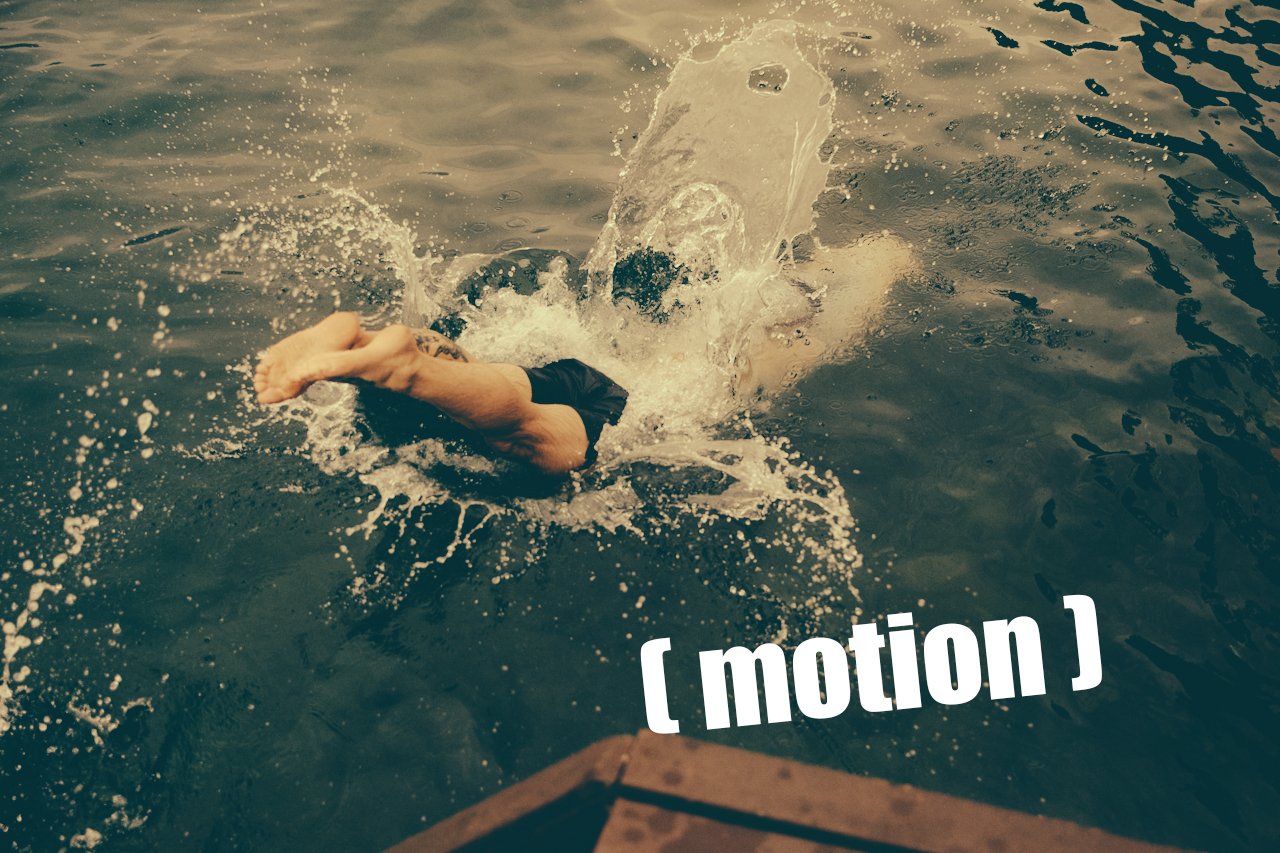
A tabletop still photograph is a single statement. A tabletop motion sequence is a conversation. The product has to do something, reveal something, or change in some way that justifies putting it in motion. This week is about learning to think in cuts and sequences.
Presentation Flow
Opening: What makes a tabletop sequence different from a tabletop still (8 minutes)
In still photography, you solve the frame once. Everything is optimized for a single moment; the composition, the light, the styling. In a motion sequence, you are solving for multiple moments that have to work together. A beautiful frame that does not connect to the frame before or after it is useless footage.
Three things that change when you add motion to tabletop work:
- Styling decisions become timing decisions. Where you place a prop is now also a question of when it appears in the sequence and how it enters the frame.
- Light consistency across multiple angles is a real problem. A still photographer can adjust the light for every frame. A motion sequence shot from three angles needs light that works for all three simultaneously, or you need to lock each angle and reshoot.
- The viewer’s eye needs to be led. In a still, composition does that work. In a sequence, editing and camera movement share that responsibility. You have to plan for both.
Thinking in sequences: beginning, middle, end.
Even a 10-second tabletop sequence tells a small story. It does not need a plot. It needs a direction — a sense that something has changed or been revealed between the first frame and the last.
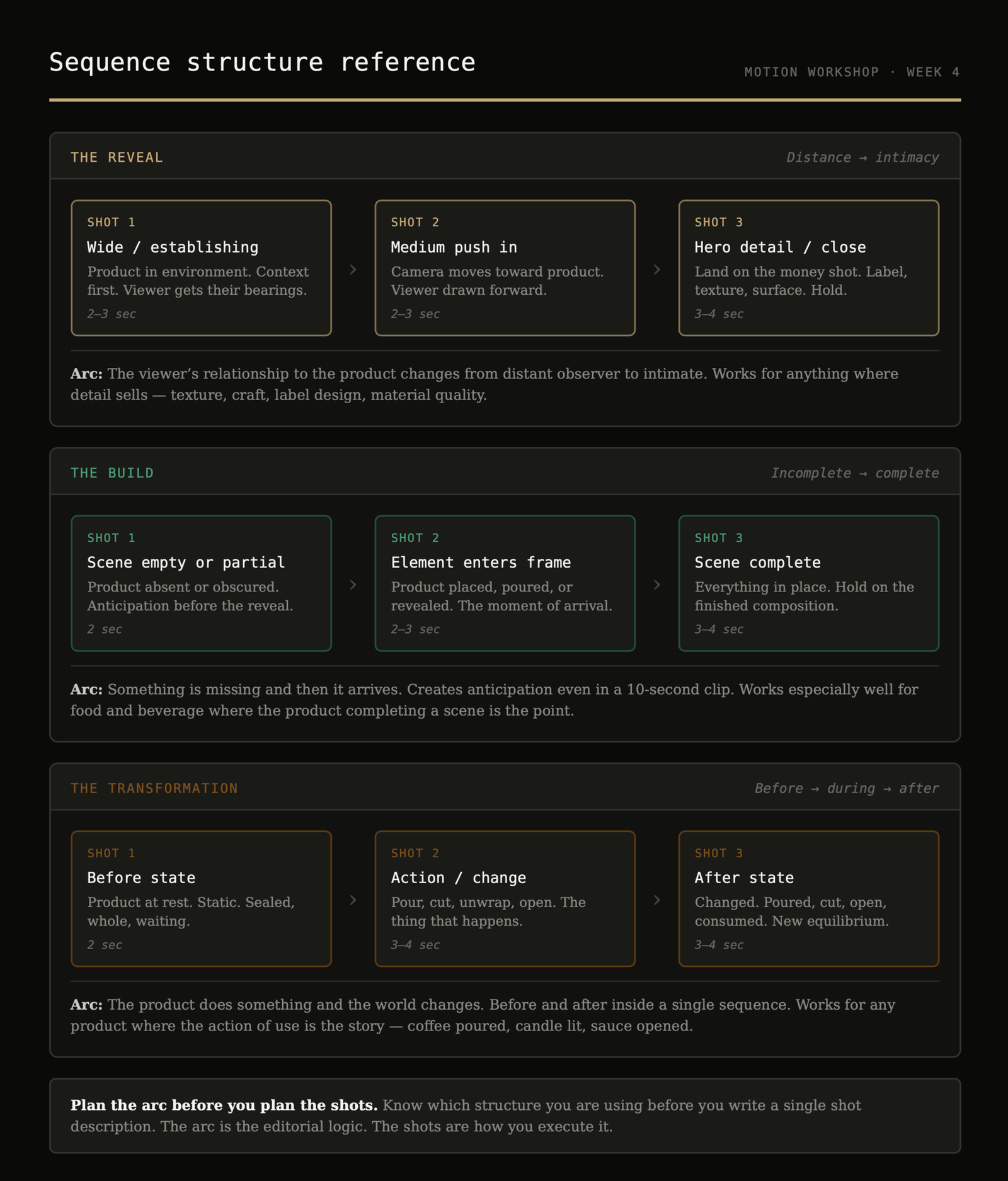
Three sequence structures that work reliably for product tabletop:
- The reveal: start wide or obscured, move toward or into the product, end on the hero detail. The viewer’s relationship to the product changes from distant to intimate.
- The build: elements come into frame sequentially (one-after-another). A coffee cup appears, then steam rises, then a hand wraps around it. Each element adds to the scene until it is complete.
- The transformation: something about the product or environment changes during the sequence. A pour, a cut, an unwrap. Before and after within a single sequence.
Camera angles for tabletop motion: what works and what does not
Still photographers know their tabletop angles; high hero, 45-degree, straight-on, low hero. Motion adds a dimension to each of those choices because the camera can move between or within angles.
The angles that translate well to motion:
- High hero moving to 45-degree: a slow tilt or arc down from overhead to eye level shows the product’s context and then its detail. Works for food and beverage especially.
- Straight-on slow push: the simplest move and still one of the most effective. The product fills the frame progressively. Works for almost anything with a strong front face — a label, a logo, a designed surface.
- Low hero static with product movement: camera stays low and locked, something happens on the surface above it. A pour comes down into frame. A hand places the product. The low angle makes ordinary actions feel cinematic.
- Overhead locked with element build: camera looks straight down, elements enter the frame from the edges. This is the foundation of a lot of food and lifestyle motion content and it edits together cleanly.
What doesn’t work: constantly changing angles with no editorial logic, moving the camera and the product simultaneously with no clear focal point, cutting between angles that have inconsistent light.
Multi-shot thinking: planning a sequence that edits together
A sequence that edits together cleanly needs four things planned in pre-production:
Consistent eyeline.
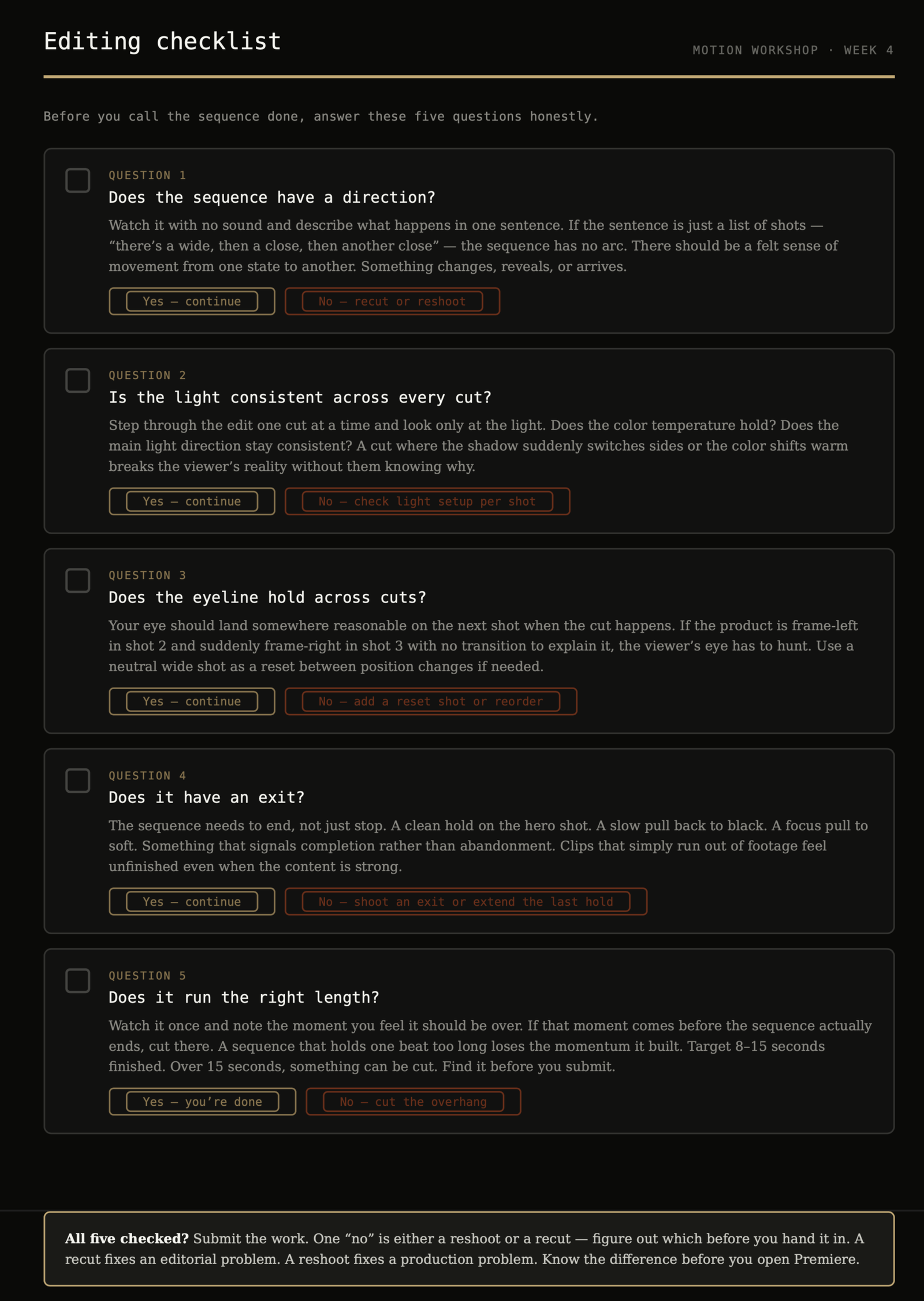
If the viewer’s eye is following the product through the sequence, each cut needs to land the eye roughly where it left off. Cuts that jump the eye to a completely different part of the frame require the viewer to reorient, which breaks flow.
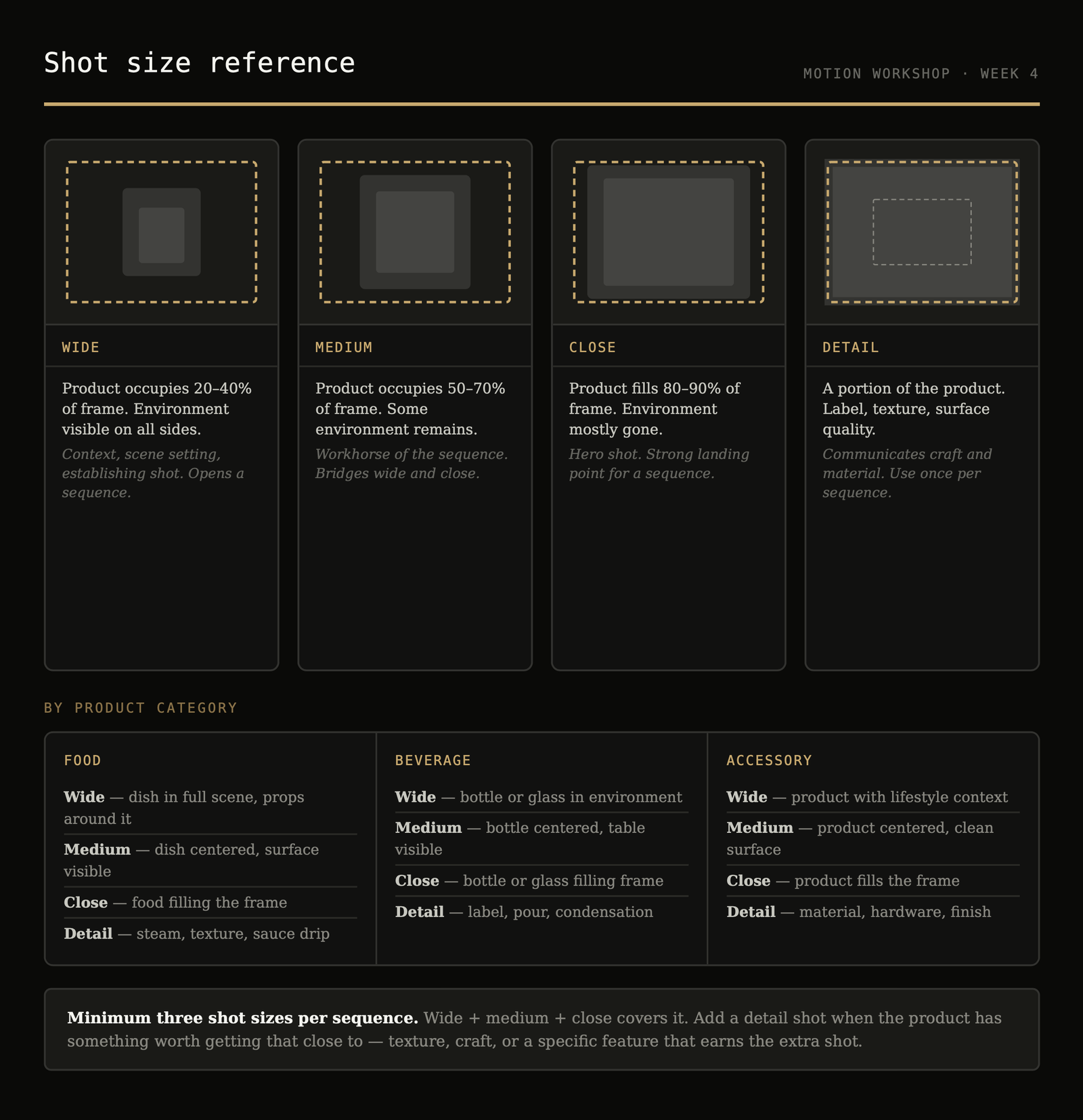
Shot size variation.
A sequence of three shots all at the same focal length and distance is monotonous. Plan for at least one wide, one medium, one close in any sequence of three or more clips.
Light continuity.
If the light changes between angles, it needs to feel motivated — a different time of day, a different environment — not accidental. For a single-session tabletop shoot, keep the light locked and reframe the camera, not the light.
An exit.
The sequence needs to end somewhere. A static hold on the hero shot, a slow pull out to black, a focus pull to soft; anything that tells the viewer the sequence is complete. Clips that simply stop feel unfinished.
A solid shot list for a complete tabletop sequence: four to six shots, overhead to close, with timing notes for each.
Assignment: Tabletop Sequence
Same product category — food, beverage, or lifestyle accessory. They can introduce a new product or continue with what they have been shooting.
The setup constraints:
- Minimum three shots that cut together as a sequence
- At least one overhead or high hero angle and one close detail shot
- Light stays consistent across all angles; no resetting between shots
- Total sequence length : see assignment below
Deliverables:
CLIPS OR STOP MOTION
A. Video clipS (2) 1 8-second, 1 12-second (NOTE: THESE ARE HARD SET TIMES.)
B. Stop Motion (2) 1-8-second, 1 12-second (NOTE: THESE ARE HARD SET TIMES.)
C. 1 stop motion (8-seconds), 1 video clip (same subject) 12-seconds. (NOTE: THESE ARE HARD SET TIMES.)
What we’re looking for in a critique:
- Does the sequence have a direction?
- Can you feel a beginning, middle, and end even without audio?
- Do the shots cut together cleanly: consistent light, logical eyeline, shot size variation?
DOWNLOAD THE PDF
DOWNLOAD PDF
DOWNLOAD PDF
Download the presentation.