
The Mentor's Corner
Business and Marketing for ProsIs Your Portfolio Ready for Tomorrow’s Meeting?
Building a Market-Ready Portfolio
A portfolio isn’t a scrapbook. It’s not a memory wall or a “greatest hits” reel. It’s your visual sales tool—the clearest expression of what you do, how you think, and why someone should hire you.
If Chapter 2 helped you define your niche, this chapter shows you how to prove it—with strategy, curation, and intent.
Your Portfolio Is a Business Tool
Your images don’t just need to be good—they need to be useful. To the viewer. To the client. To the job you want next. A market-ready portfolio isn’t about showing off, it’s about showing up—with work that says:
“This is what I do. This is who it’s for. And yes, I’m ready.”
Curate With Intention
Start with 20–30 images. That’s it. Every image should earn its place.
Ask yourself:
-
Can someone instantly tell what I specialize in?
-
Do these images look like they came from the same photographer?
-
Would a paying client want work like this?
Leave out the one-off experiments. Ditch anything that doesn’t align. Consistency beats variety. You’re not showing everything—you’re showing the right things.
Group Your Work Like a Buyer Would
Don’t make clients work to “get” you. Instead, organize your portfolio the way they think:
-
Product: Clean on-white shots, styled product scenes, or packaging in context
-
Food: Flat lays, plated dishes, restaurant environments, process shots
-
Lifestyle: Branded scenarios, natural moments, people interacting with products
-
Editorial: Story-driven imagery with a sense of narrative and place
Clear categories make it easier for clients to self-select—and for you to be taken seriously in your niche.
Show Range Without Losing Focus
Yes, clients want specialists. But they also want to know you’re versatile within your lane.
Let them see:
-
Bright daylight and dramatic controlled lighting
-
Studio cleanliness and on-location chaos
-
Detail shots and environmental context
Keep your visual language consistent—so even with variety, there’s a throughline of you in every frame.
Sequence Like a Story
Whether it’s a website, PDF, or print book—order matters.
-
Start strong. Lead with your best image.
-
Build rhythm. Mix wide and tight shots. Vary pacing.
-
End memorably. Your second-best image goes last—leave them with impact.
You’re not just showing work. You’re guiding a feeling.
Context Is a Multiplier
Add short captions where it helps. No fluff—just function.
“Shot for X brand’s spring campaign. Used in print, web banners, and point-of-sale.”
That context shows you’re client-ready. You think in deliverables, not just images.
No Client Work?
No Problem.
Make Your Own.
You don’t need to wait for permission to prove what you can do. Fill gaps with intentionally crafted personal projects.
-
Mock up a campaign for your dream brand
-
Style and shoot your favorite products as if hired
-
Create a photo essay for a magazine that doesn’t exist (yet)
If it solves a client problem and fits the brief—you’re already doing the work.
Format Like You Mean It
One portfolio isn’t enough. You need options:
-
Website: Clean, fast, and updated quarterly
-
PDF: Easy to send with cold pitches or follow-ups
-
Case Studies: For your blog, newsletter, or deck
-
Instagram: Not just pretty—aligned
Every platform is a handshake. Make sure your grip is solid.
Review Quarterly, Ruthlessly
Your portfolio is a living document. Set a date every quarter to:
-
Add new work that fits your direction
-
Remove anything that feels tired, off-brand, or below your current standard
-
Re-sequence for flow and relevance
You’re only as strong as your weakest image. Don’t let old work sabotage new opportunities.
Final Thought
A great portfolio doesn’t just get attention—it builds trust. It doesn’t say “look what I can do.”
It says, “This is exactly what you’ve been looking for.”
When you align your focus (Chapter 2) with your presentation (this chapter), you don’t just look professional. You are a professional.
Recent Business Posts
No Results Found
The page you requested could not be found. Try refining your search, or use the navigation above to locate the post.

The Parable of Two Dogs
THE PARABLE OF TWO DOGS I was recently reminded of this wonderful story. An old Cherokee is teaching his grandson about life: “A fight is going on inside me,” he said to the boy. ”It is a terrible fight and it is between two dogs. One is evil–he is anger,...

You Execute on What You Believe – And That May Be Problematic
(Look at that tree clinging to a tiny piece of dirt in the middle of a rock wall. It isn't supposed to be able to do that. There is barely enough sunlight in that narrow ravine, nor is there sufficient water on the side of a cliff. Good thing the tree...

Why Weekly Assignments Work (and why I love Unsplash)
When I started Project 52 Pros back about 7 years ago, I knew I wanted it to introduce a wide variety of commercial photography to photographers who were not steeped in that tradition. It is difficult to find assistant gigs, and even harder to find them when you are...

Article for Petapixel: Pricing Work by Understanding Value
"The fact that you own a lot of gear that cost a lot of money, have purchased a vehicle to transport that gear, and spent long hours mastering its use is a given. Of course you have. Otherwise you would not be a professional photographer. Period. I do not care how...
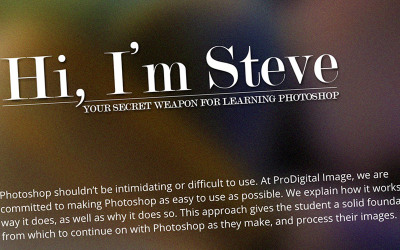
Site Redesign: Pro Digital Image
My bud Steve Burger is the driving force of Pro Digital Image. He is a Photoshop genius who loves to make photographs, awesome prints, and teach. He has been THE guy to go to for Photoshop in Phoenix and Arizona for more than a decade. I have built all of his...

A Fresh Face for J Morgan Images
We made a few simple tweaks to J Morgan Images, a consumer photography website by photographer Jessica Edler. You can see what we did and keep these few ideas in mind. Get your clients and visitors STRAIGHT to the imagery. Do not use 'cover pages' or 'entry pages' as...