
Module Two-B: A 14-Day Plan
This is a look at how to create your plan of attack.
Here you go. Take this and make it work for you.

Course Details
Module Two B
A Sample Plan
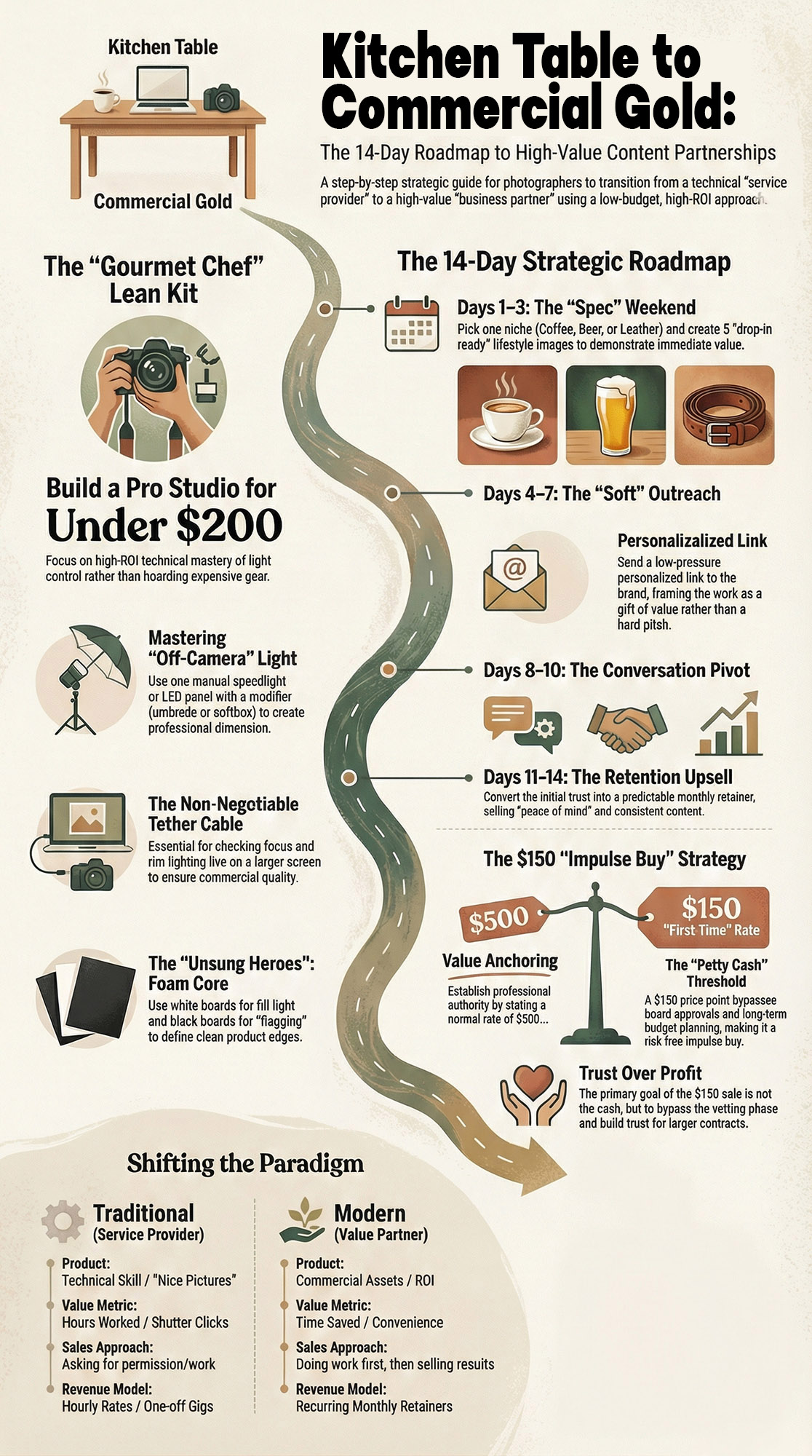
14-Day Strategic Roadmap: Launching a Commercial Content Business
1. The Strategic Pivot: Shifting from Service Provider to Value Partner
The modern digital economy has rendered traditional photography business models obsolete. Most creators fail because they position themselves as technical laborers—selling shutter clicks and hourly rates—rather than business partners who solve specific revenue-driving problems. This 14-day framework optimizes the creator’s unit economics by front-loading value to bypass traditional procurement friction. By prioritizing speed, convenience, and tangible market-ready assets over abstract “artistry,” this roadmap establishes a high-value relationship before a contract is even discussed.
The Content vs. Photography Paradigm
To scale a commercial operation, one must move away from the “photography” label. While photography is often viewed as a discretionary expense or a luxury technical skill, “content” is a business-critical fuel for the digital era. Transitioning to a content-focused model means evaluating the output through the lens of commercial utility. Clients do not need “nice pictures”; they need high-velocity assets that populate social feeds, drive engagement, and convert browsers into buyers. By selling a business solution (content) rather than a technical skill (photography), the creator pivots from a replaceable commodity to a vital business component.
The “Time Saved” Proposition
The primary friction point for small business owners is the administrative and creative burden of maintaining a digital presence. This roadmap pivots the sales pitch away from technical proficiency and toward operational efficiency.
Feature |
Old Model (Service Provider) |
New Model (Value Partner) |
|
Primary Product |
Technical Skill / Photography |
Commercial Content / ROI Assets |
|
Value Metric |
Hours worked or shots taken |
Time Saved and Convenience |
|
Engagement Type |
Asking for permission/work |
Doing work first, then selling results |
|
Pricing Basis |
Cost-plus or hourly rates |
Value-based / Impulse-buy anchoring |
Outcome-First Methodology
The strategic core of this framework is the “Outcome-First” approach. By performing the work before making an “ask,” the creator eliminates the inherent risk of a traditional sales pitch. Leading with results—specifically, high-quality assets already tailored to the client’s brand—demonstrates immediate competency and bypasses the “vetting” phase entirely. This shift in momentum accelerates the sales cycle from weeks of negotiation to a compressed 14-day execution.
——————————————————————————–
2. Phase 1: The “Spec” Weekend – Asset Creation and Niche Validation (Days 1–3)
The first three days constitute a high-intensity sprint to build a professional-grade portfolio from scratch. This “Spec” (speculative) weekend allows you to demonstrate your value proposition in a controlled environment, ensuring the final assets meet high commercial standards without the friction of initial client oversight.
Niche Selection Strategy: The “Pick One” Rule
Strategic focus is paramount. You must pick ONE niche for this 14-day sprint to avoid analysis paralysis and ensure your portfolio demonstrates deep category authority. The recommended niches—Coffee, Beer, or Leather—are chosen because they represent high-churn, high-margin consumer products that require frequent visual updates to maintain market relevance. They are products that rely on sensory-driven storytelling to move inventory.
The “Shoot the Gap” Methodology
Technical execution during this phase is focused on “Shooting the Gap”—identifying the massive delta between how a business currently presents its product and how the market expects to see it.
• The Transformation: Take products from “dark/messy” environments and reposition them into “bright/clean/lifestyle” assets. You are not just changing the lighting; you are elevating the perceived market value of the product.
• The Deliverables:
◦ 5 Professionally Edited Images: These must be “drop-in ready” for a commercial marketing campaign.
◦ The Professional Link: Presentation is as critical as the work. Use a high-end gallery platform like Pixieset or Adobe Portfolio. Sending a Google Drive or Dropbox link signals amateur status; a curated gallery signals a high-ticket consultant.
Resource Allocation
This phase requires a strategic “no-charge” investment. Visit the shop and purchase the product yourself. This establishes immediate professional autonomy—you own the product, which means you have the freedom to experiment with lighting and styling without the pressure of a live client shoot or the need for a “permission-based” entry.
——————————————————————————–
3. Phase 2: The “Soft” Outreach – Low-Friction Market Entry (Days 4–7)
Once the assets are polished, the focus shifts to market entry. The psychology of “Soft” outreach is designed to open a line of communication without the adversarial pressure of a hard sales pitch. You are not a beggar looking for work; you are a professional providing a solution to a problem they already have.
Omnichannel Contact Strategy
Utilize a dual-path approach to reach the decision-maker:
• DM or Email: Best for digital-native brands where you can include a direct hyperlink to your Professional Gallery.
• Walk-in: Ideal for local artisan shops (Coffee/Leather) to build immediate rapport.
• The Script Framework: Your message must be low-pressure. “I was in the shop recently, love the product, and took some lifestyle shots for a project I’m working on. Thought you might like to see them for your socials—here’s the link.”
Establishing the Professional Bridge
Your high-end gallery link acts as the silent salesperson. Instead of describing what you could do, you are showing them what you have already done for their specific brand. This bridge transforms the outreach from a “pitch” into a “gift of value,” which triggers the psychological principle of reciprocity.
——————————————————————————–
4. Phase 3: The “Conversation Pivot” – Value Anchoring and the Impulse Buy (Days 8–10)
The “Conversation Pivot” occurs when the prospect responds with interest—usually asking, “Wow! These are great, how can we use them?” This is the moment you transition from a “creator” to a “commercial strategist.”
The Psychology of Value Anchoring
To maintain high-ticket authority, you must establish a “Price Anchor” before revealing your actual rate.
• The Anchor: State clearly that your “Normal Rate” for a commercial shoot and licensing of this quality is $500.
• The Pivot: Offer the five images they are currently looking at for a “Special First-Time License Rate” of $150.
The “No-Risk Impulse Buy” Framework
By pricing the first five images at $150 against a $500 anchor, you create an irresistible impulse buy. For a small business owner, $150 is “petty cash”—it doesn’t require board approval or long-term budget planning. This initial transaction is a tactical maneuver to build the trust necessary to transition the client into a recurring revenue engine.
——————————————————————————–
5. Phase 4: The Upsell – Securing the Monthly Retainer (Days 11–14)
The final phase moves the client from a one-time transaction to a predictable, recurring monthly retainer. This is where you achieve business stability.
The Retainer Proposal
The upsell is framed through the “Time Saved” philosophy. You are selling them the peace of mind that their marketing assets for the entire month are handled.
• The Offer: 12 fresh images per month for $400.
• The Strategic Benefit: The client receives a consistent stream of professional content for less than the cost of one “Normal” shoot ($500). You secure stable monthly recurring revenue (MRR) and a simplified workflow.
Scaling to the Second Job: The Growth Checklist
Once the first retainer is secured, the 14-day cycle becomes a repeatable engine. To scale, execute the following:
1. Efficiency Audit: Analyze the “Spec” weekend of your first client. Which lighting setups and props worked fastest? Standardize these into a “Brand Kit” to reduce Phase 1 labor for the next client.
2. Cross-Niche Replication: Select a complementary niche (e.g., if you started with Coffee, move to a Bakery) and repeat the “Shoot the Gap” methodology using your first client as a social proof case study.
3. Active Lead Generation: Allocate the revenue from your first $150 “Impulse Buy” into purchasing products for your next three “Spec” weekends, ensuring the engine remains fueled by profit, not debt.
Final Synthesis
This 14-day roadmap is a high-level business development operation. By front-loading value and treating content as a commercial asset rather than an artistic endeavor, you eliminate the “starving artist” trope. Success in the content economy belongs to those who sell results, speed, and convenience.